7 UpKeep alternatives: Specialized tools for maintenance and asset management teams (2026)

UpKeep is one of the leading CMMS platforms, offering maintenance teams a mobile-first solution for work orders, preventive maintenance scheduling, asset tracking, and parts inventory. Its Nova AI agent, IoT sensor connectivity through Edge, and expanding module ecosystem (EHS, Fleet, Studio, LMS) make it a solid option for teams modernizing maintenance operations.
But as your asset management needs evolve, you may find that UpKeep’s per-seat pricing, tiered feature gating, and CMMS-first architecture don’t match how your organization actually works. Some teams need broader asset lifecycle coverage beyond maintenance. Others need better predictive capabilities, more transparent pricing, or compliance tools that UpKeep reserves for its highest-tier plans.
That’s where this guide comes in. Whether you’re looking to:
- Digitalize asset workflows across teams, suppliers, and customers in a single collaborative platform with unlimited users and AI-powered interaction
- Get started with a free CMMS that includes real-time team messaging and offline mobile access
- Connect maintenance workflows directly to industrial automation infrastructure with AI-powered failure diagnostics
- Justify capital budgets and satisfy audit requirements with strong reporting and compliance documentation
- Deploy a focused, specialist CMMS without feature sprawl or hidden implementation costs
- Equip a small team with a complete, single-plan CMMS at an all-inclusive price
- Shift from reactive maintenance to predictive maintenance with integrated condition monitoring hardware
We’ll explore alternatives that excel in these specific areas.
Some organizations might use these tools alongside UpKeep for deeper capabilities in a particular area, while others might replace UpKeep entirely with a better-suited solution. This isn’t about finding a “better” platform; it’s about finding the right fit for your business activity and team ways of working.
Let’s look at the UpKeep alternatives and find which ones fit your asset management needs.
| The best Upkeep alternatives | |
|---|---|
 | Bulbthings Best Alternative for Collaborative, All-in-One Asset Management with Unlimited Users We chose Bulbthings because it digitalizes asset workflows across internal teams, suppliers, and customers with collaborative features, a full AI agent, and customizable low-code workflows, all with activity-based pricing and unlimited users. |
 | MaintainX Best Alternative for a Free CMMS Entry Point with Built-In Team Messaging We chose MaintainX because its permanently free Basic plan with unlimited work orders and built-in real-time messaging removes the financial barrier to CMMS adoption, making it ideal for budget-constrained teams. |
 | Fiix Best Alternative for Enterprise Industrial Operations We chose Fiix because its Rockwell Automation backing, AI-powered prescriptive work orders, and industrial sensor integration make it built for large-scale manufacturing environments. |
 | Brightly Asset Essentials Best Alternative for Capital Planning and Compliance-Driven Organizations We chose Brightly because its 100+ predefined reports, full asset lifecycle tracking, and track record in education and government make it the strongest option for audit-grade asset management. |
 | Limble Best Alternative for a Focused, Pure-Play CMMS We chose Limble because it delivers strong maintenance management with all-inclusive pricing, 30+ language support, and the fastest implementation timelines in the category. |
 | Click Maint Best Alternative for Small Teams Needing Simple, Transparent Pricing We chose Click Maint because its single-plan pricing with no feature tiers and 1-2 day implementation timeline make it the lowest-friction path from spreadsheets to structured maintenance management. |
 | TRACTIAN Best Alternative for AI-Powered Predictive Maintenance with Integrated Sensors We chose TRACTIAN because its integrated sensor hardware and AI diagnostic engine detect 35+ fault modes in rotating equipment, making predictive maintenance accessible without in-house vibration analysts. |
What is UpKeep?
UpKeep is a mobile-first CMMS and Asset Operations Management (AOM) platform designed for maintenance, operations, and reliability teams at asset-intensive organizations.
Founded in 2015 by Ryan Chan, a former process engineer who built the product after watching technicians handwrite notes in the field and retype them at their desks, UpKeep was built to bring maintenance management to mobile devices.
Its key features include:
- Work order management with mobile creation, photo annotation, QR code scanning, and a drag-and-drop scheduler
- Preventive maintenance scheduling with calendar-based, meter-based, and seasonal triggers
- Asset tracking with full maintenance history, QR code labels, and lifecycle data
- Parts and inventory management with low-stock alerts, cycle counts, and multi-location tracking
- Nova AI agent that reviews data, audits parts, reprioritizes work orders, and creates work orders by voice
- Edge IoT sensors for condition-based monitoring of temperature, vibration, humidity, and current
- EHS module for incident reporting, OSHA compliance, and safety work orders
- Fleet management for vehicle inspections, usage-based PM, and telematics integration
- Studio for building custom no-code apps on top of UpKeep data
When a technician receives a work order on their phone, they can scan the asset’s QR code, view its full maintenance history, log parts used, capture photos, and close the job from the field. Nova AI runs on a schedule to surface insights and automate routine administrative decisions.
UpKeep serves over 4,000 businesses including Unilever, PepsiCo, Chevron, Caterpillar, and Shell, and holds recognition as a Leader in the IDC MarketScape for SaaS CMMS and a Customers’ Choice on Gartner Peer Insights. With 952+ verified G2 reviews and a 4.5/5 average rating, it has strong credibility in the CMMS market.
However, as organizations’ needs expand beyond maintenance, some teams find that UpKeep’s per-seat pricing escalates with headcount, advanced features sit behind higher-tier plans, reporting requires heavy configuration, and the CMMS-first architecture doesn’t cover the full asset lifecycle. That’s why we’re exploring alternatives that address these gaps.
Looking for a platform that digitalizes your asset workflows with collaborative features across teams, suppliers, and customers, all with unlimited users? Discover how Bulbthings can simplify your operations.
How We Curated Our List of UpKeep Alternatives
After testing UpKeep and researching the maintenance and asset management market, we focused on tools that address specific needs where UpKeep falls short. While UpKeep excels as a mobile-first CMMS, some organizations need tools for:
- Digitalizing asset workflows across internal teams, suppliers, and customers with collaborative features, AI interaction, and multi-class asset coverage (without per-seat cost escalation)
- Getting started with digital maintenance management at zero cost, with built-in team communication
- Connecting maintenance workflows to existing industrial automation infrastructure with AI-powered failure prediction
- Justifying capital budgets and satisfying external audit requirements with analytics and compliance documentation
- Deploying a specialist CMMS that does maintenance well without module sprawl
- Equipping small teams with a complete CMMS at a flat, predictable price
- Shifting from reactive to predictive maintenance using integrated condition monitoring hardware and AI diagnostics
Each tool on this list leads in one of these areas. You might use them alongside UpKeep or switch entirely; it depends on what your operation needs most.
| ❗DISCLAIMER: We aren’t covering every single tool in the market! Our focus is on highlighting the best alternatives that address some of UpKeep’s limitations for various use cases. The goal is to provide insights into tools that cater to specific business needs. |
|---|
1. Bulbthings – Best Alternative for Collaborative, Multi-Class Asset Management with Unlimited Users
Source: Bulbthings
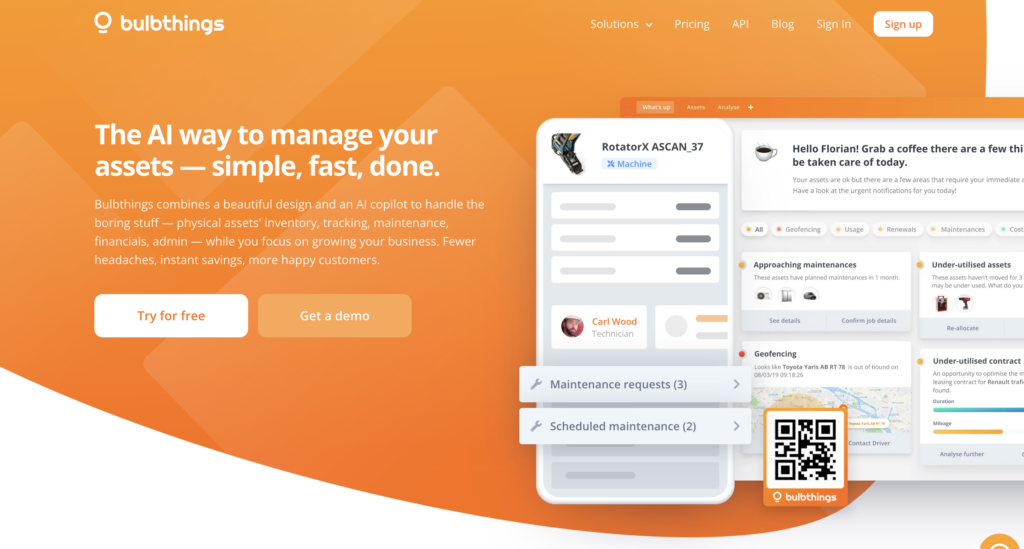
Bulbthings is the collaborative, AI-powered platform that empowers growing businesses to digitalize any asset-centric process with total flexibility. While tools like UpKeep focus heavily on maintenance management (CMMS), and traditional Enterprise Asset Management (EAM) systems require costly, months-long implementations, Bulbthings offers a refreshing middle ground: a complete, all-in-one asset ecosystem with affordable, modular pricing.
Specifically tailored for the agility of mid-size companies, Bulbthings goes far beyond simple repair tracking without the enterprise bloat. It serves as a unified workspace to manage your entire asset lifecycle—from procurement and daily operations to maintenance and final disposal. You only pay for the modules you need, allowing you to scale your workflows organically and achieve rapid time-to-value without the heavy upfront burden.
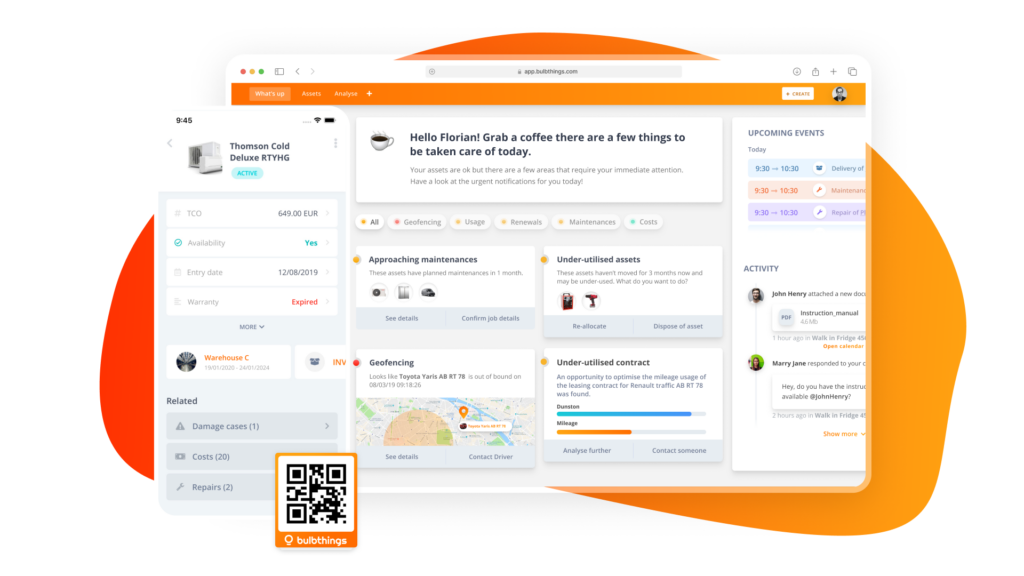
Its architecture is purpose-built to handle multiple asset classes—including equipment, vehicles, buildings, IT assets, and consumables—integrated with structured collaboration and customizable workflows.
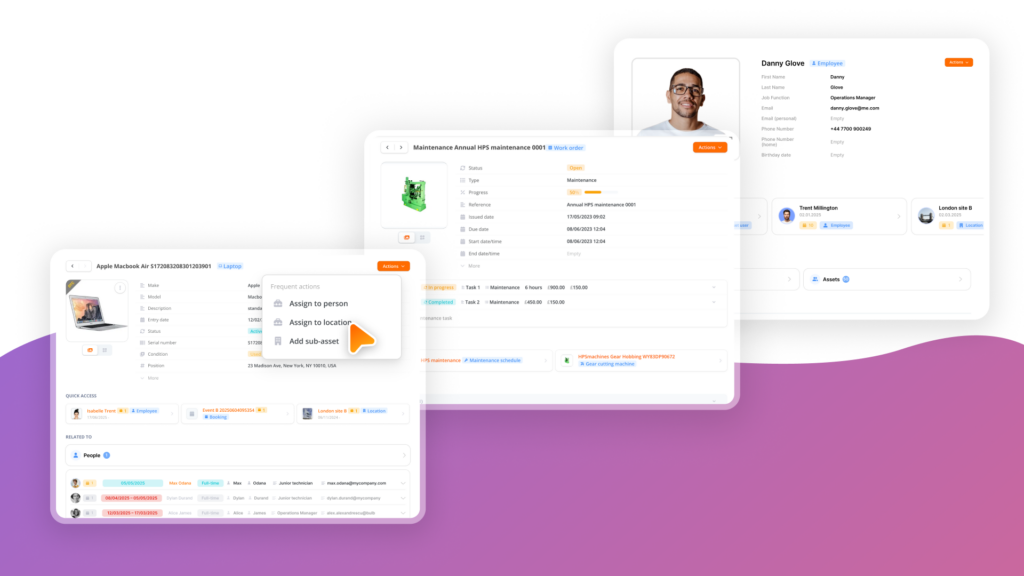
- Clean, intuitive design with an interface that reduces training and onboarding time, built to be immediately understandable while remaining customizable
Source: Bulbthings
- Mobile app with QR code and NFC scanning, photo capture, Bulb AI interaction, and limited offline capabilities
- Collaborative workflows with workspace management for different teams, workflows connecting internal departments with external suppliers and customers, cross-country collaboration with multi-language, currency, and metrics support, and granular role-based permissions configurable on virtually any criteria
- Bulb AI agent that lets users interact with the platform in natural language to create, book, and assign assets, log maintenance, generate reports, and query data (including image recognition to add assets via the mobile app)
- Asset inventory and tracking with a unified register covering serialized equipment, bulk consumables, vehicles, buildings, and tools in a single data model, with QR code and NFC scanning, and multiple views including registers, stock levels, floor maps (indoor), GPS maps (outdoor), and planning views
Source: Bulbthings
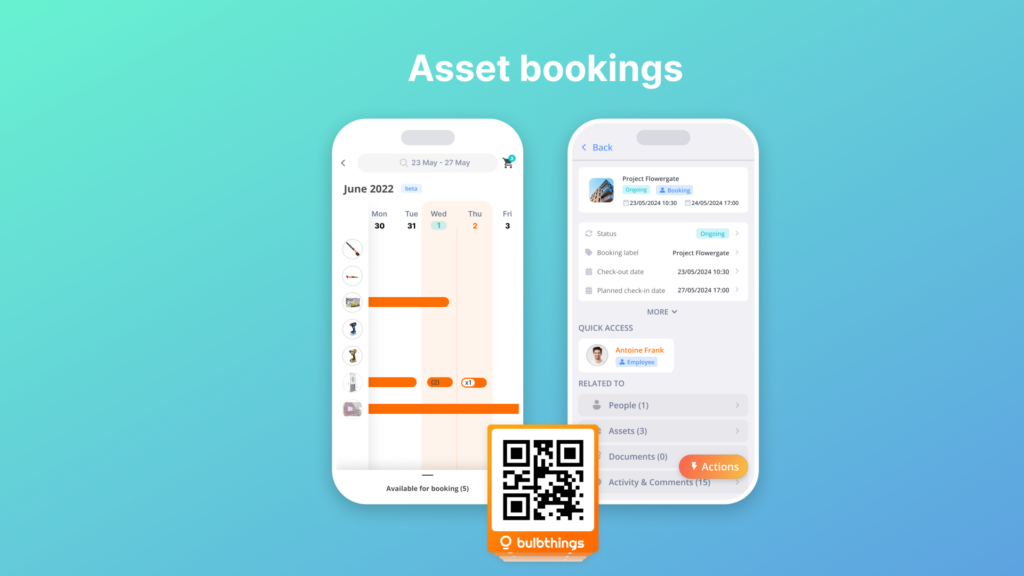
- Asset check-out/check-in and bookings workflows to handle different use cases (bookings via store manager or self-booking), bookings approval steps and acceptance with electronic signature.
Source: Bulbthings
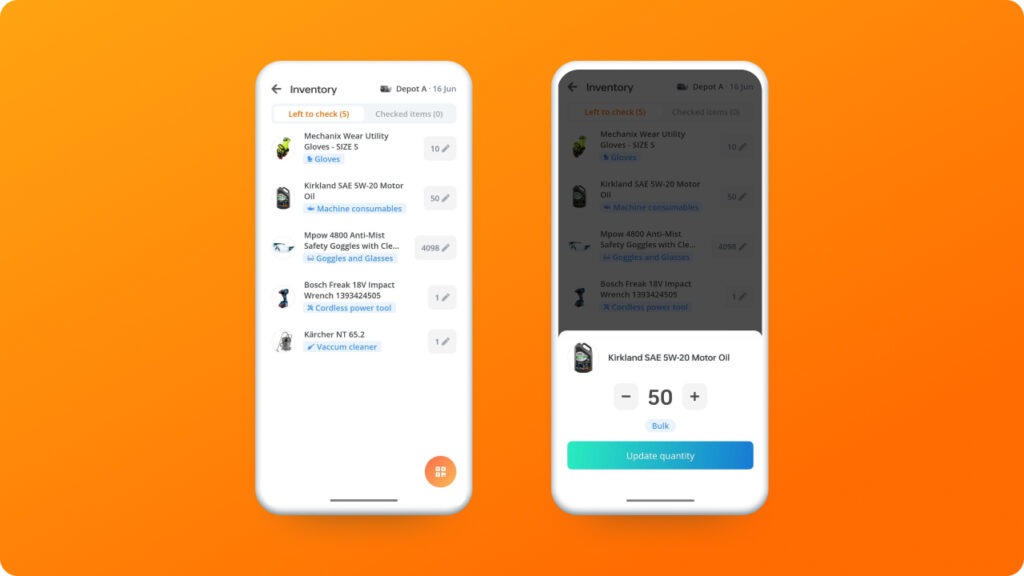
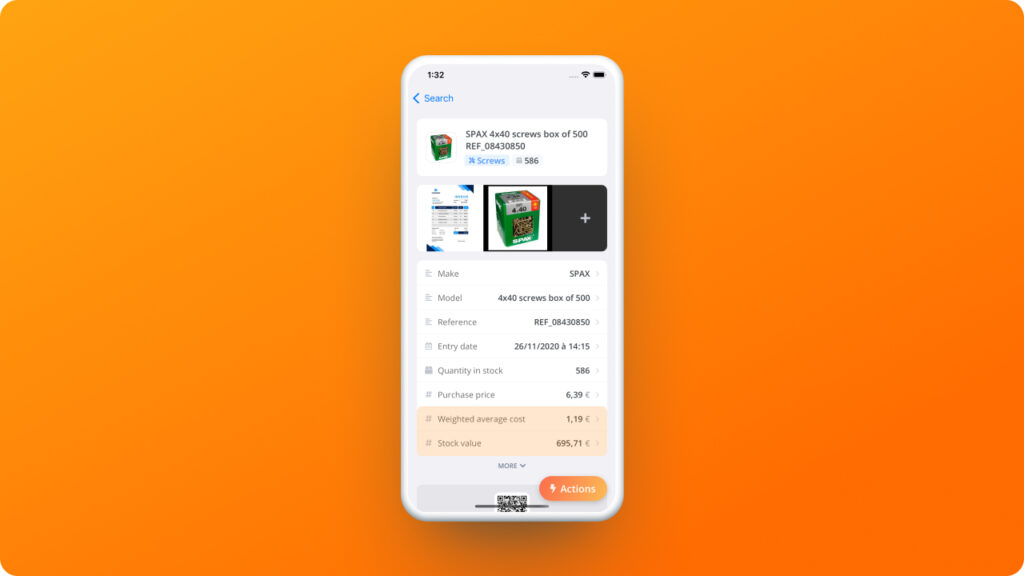
- Advanced stock management with stock intake, allocation to locations and people (including PPE and materials tracking), stock value calculation, min/max stock level alerts, and stock level trends and reporting
Source: Bulbthings
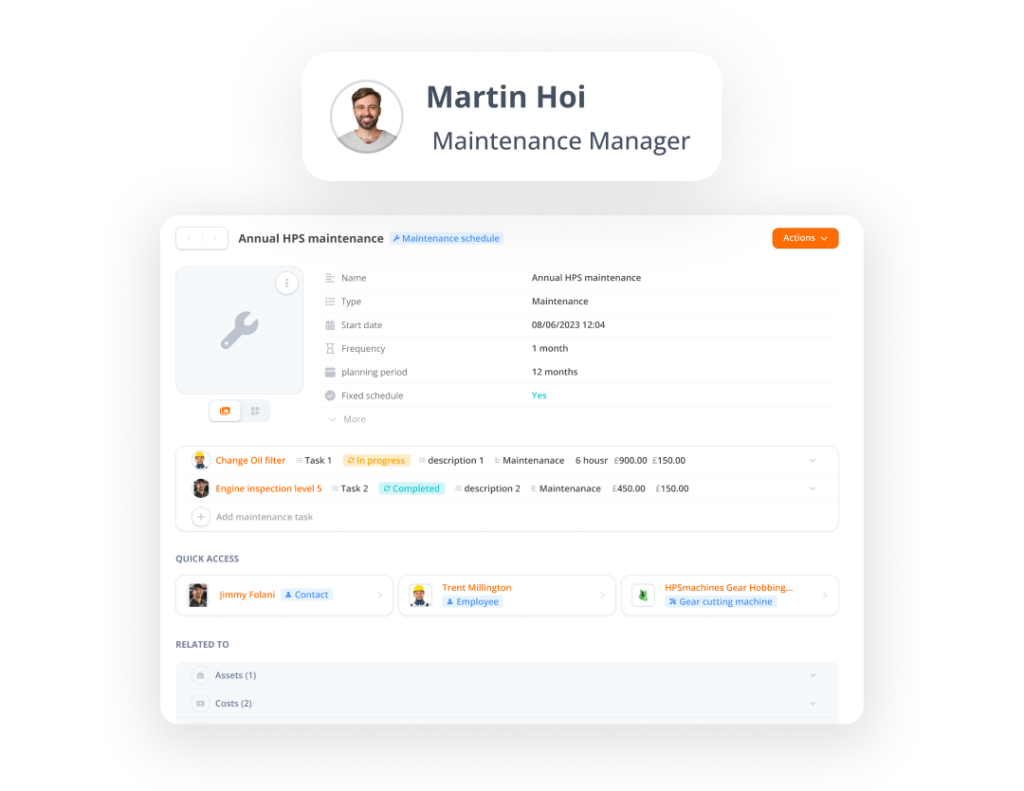
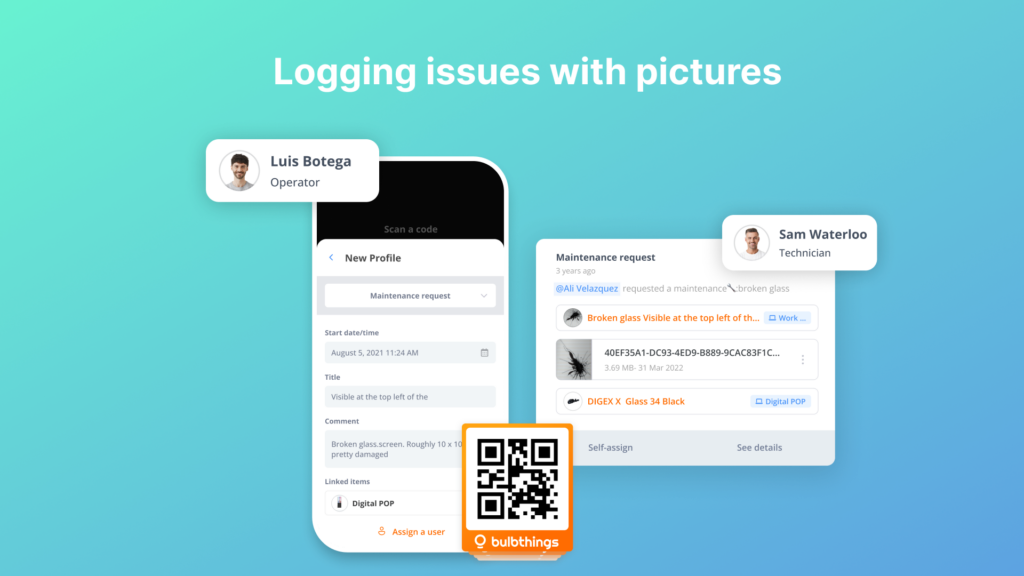
- CMMS and maintenance management with corrective and preventive work orders, calendar/meter/condition-based scheduling, and anonymous QR code maintenance requests from anyone without an account.
Maintenance schedule example:
Source: Bulbthings
Maintenance request example:
Source: Bulbthings
Technician work orders tracking:
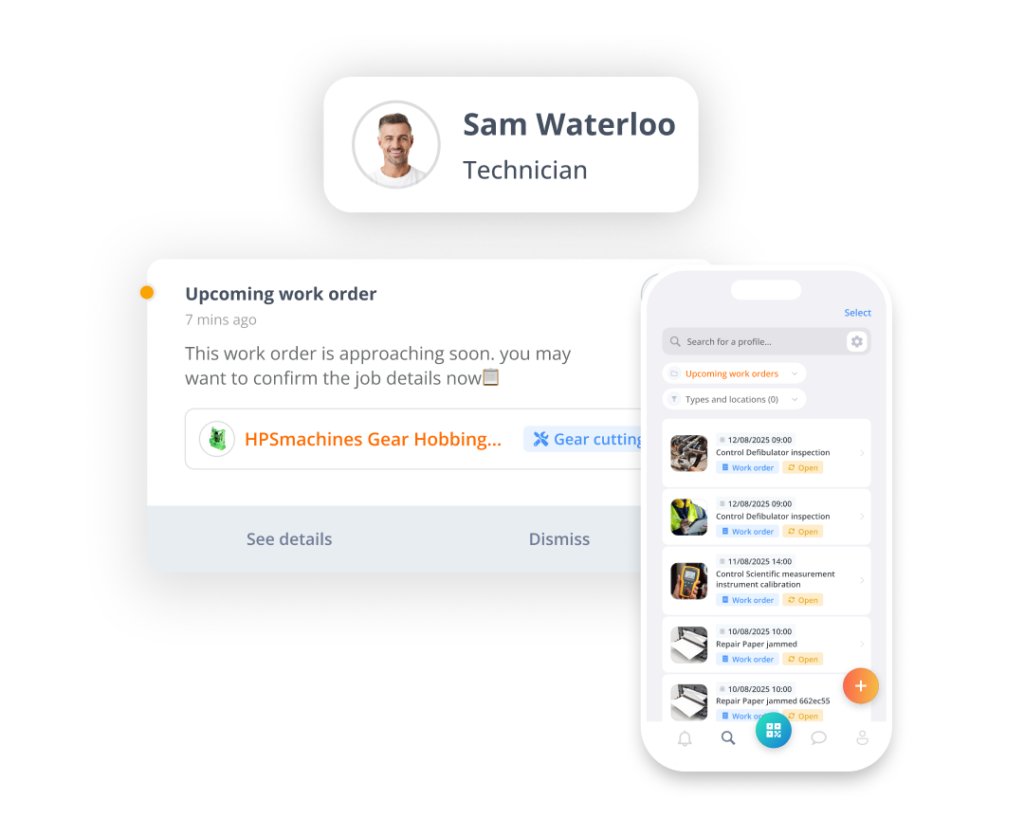
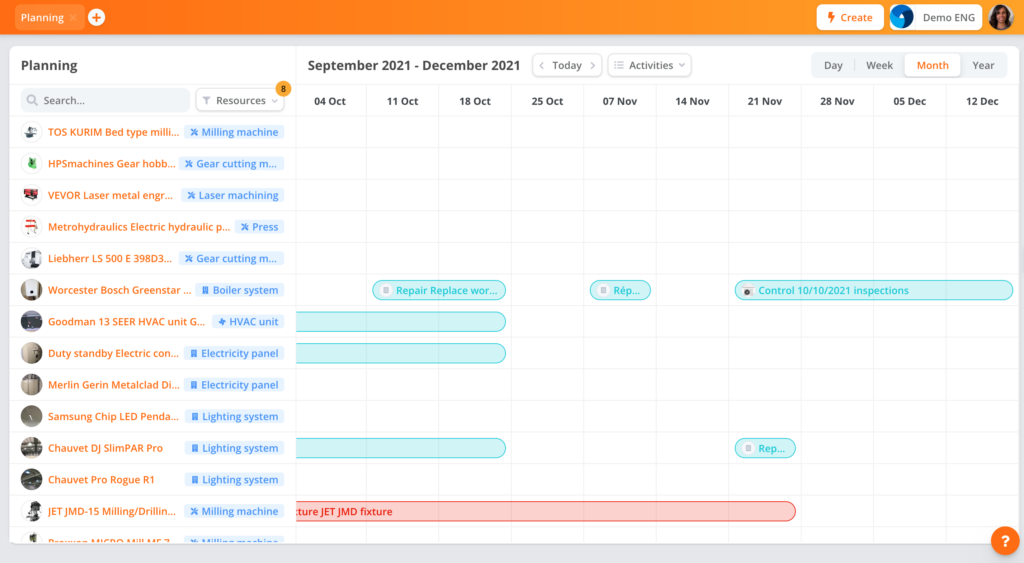
Assets or technicians schedule:
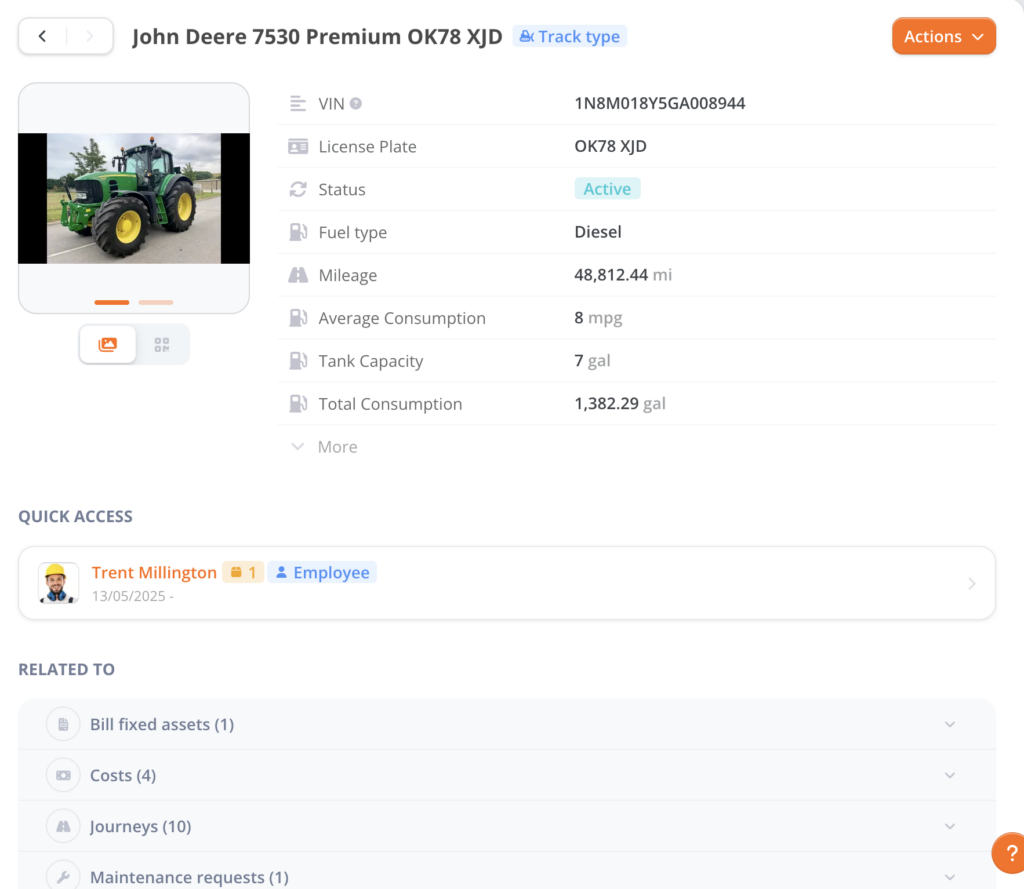
- Vehicles and Plant Full Fleet Management with mileage tracking, fuel consumption tracking, driver incident reporting, fines and damages management, corporate fleet leasing contract comparison, and TCO calculation
- Service Providers and Rental/Leasing Management covering front-office operations (customer records, CRM integration, quotation and invoicing), logistics (supplier records, delivery management, end-of-rental checks), and back-office operations (stock management, maintenance, financial reporting)
- Financial management with cost tracking, depreciation, customer invoicing, and total cost of ownership analysis across the asset lifecycle
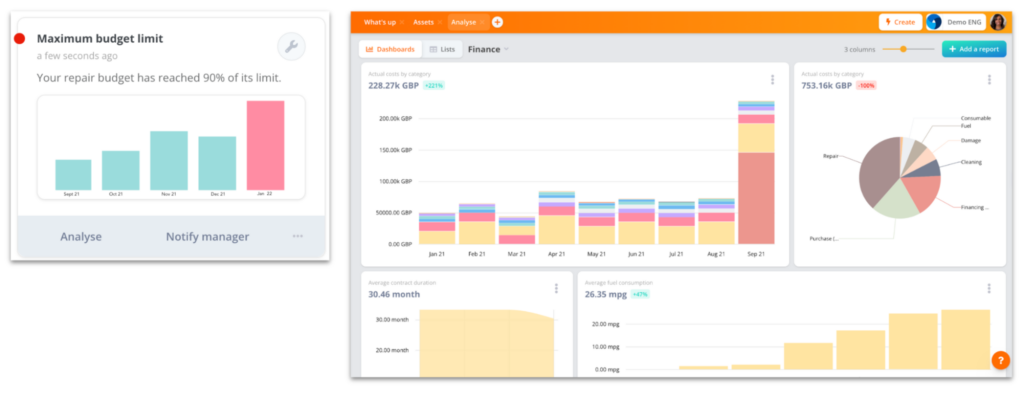
- Off-the-shelf, industry-specific workflows that are ready to go, yet fully adaptable. Thanks to its low-code/no-code technical architecture, you can easily customize validation processes, checklists, and forms to fit your exact needs.
- Telematics and IoT connectivity available as an optional add-on for GPS tracking and sensor-based asset monitoring
For mid-sized organizations managing diverse physical assets across multiple categories, Bulbthings provides collaborative breadth and workflow customization that UpKeep’s module-by-module approach cannot match in a single platform.
Critically, Bulbthings uses activity-based pricing with unlimited users included, meaning field workers, managers, suppliers, finance teams, and external contractors can all access the platform without incremental license costs.
Why Choose Bulbthings Over UpKeep for Collaborative, Multi-Class Asset Management
While UpKeep excels as a mobile-first CMMS, Bulbthings offers a different approach: a collaborative platform that digitalizes asset workflows across teams, suppliers, and customers. Here’s where Bulbthings steps up.
Collaborative Workflows Across Teams, Suppliers, and Customers
UpKeep is built around the maintenance team: technicians create and close work orders, managers review dashboards, and external collaboration is limited to work order comments and a request portal gated behind the Professional tier.
When you need to coordinate across departments, bring in external suppliers, or give customers visibility into service delivery, you’re stitching together email, WhatsApp, and Slack alongside UpKeep.
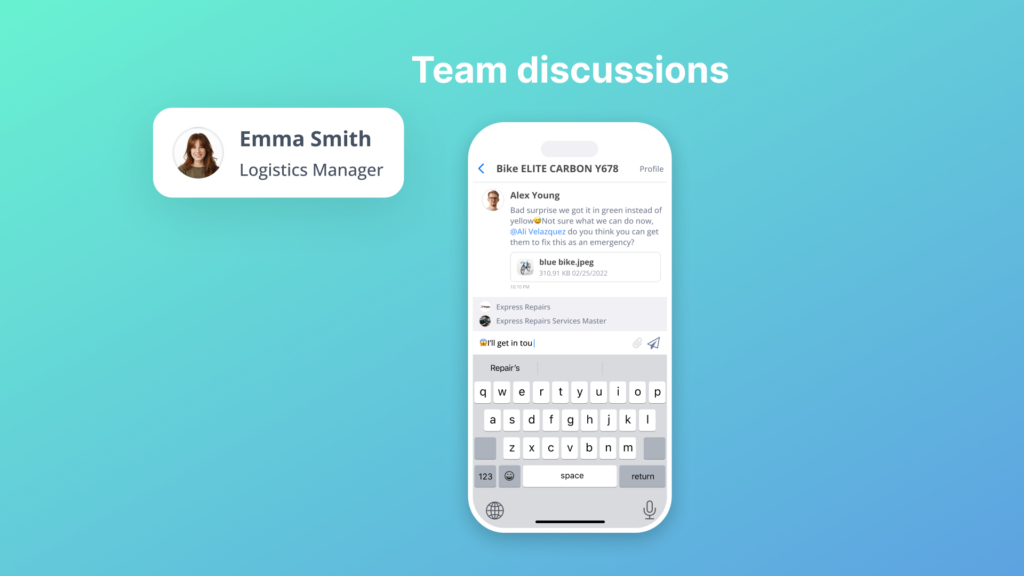
Bulbthings was designed as a collaborative workspace from the ground up. The platform provides workspace management for different teams, workflows that connect internal departments with external suppliers and customers, team discussions (a more organized “WhatsApp for assets”) and cross-country collaboration with multi-language, currency, and metrics support.
Source: Bulbthings
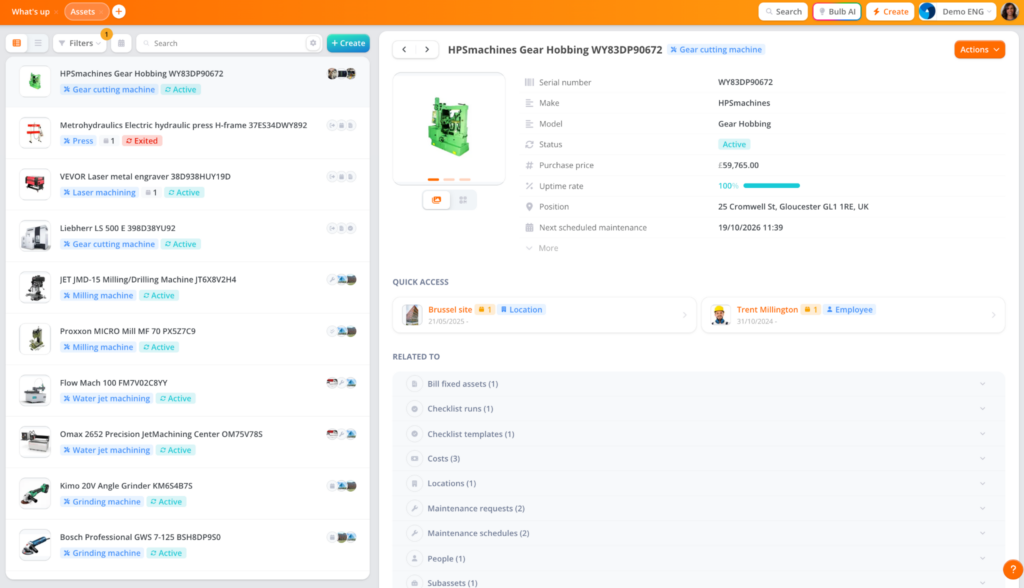
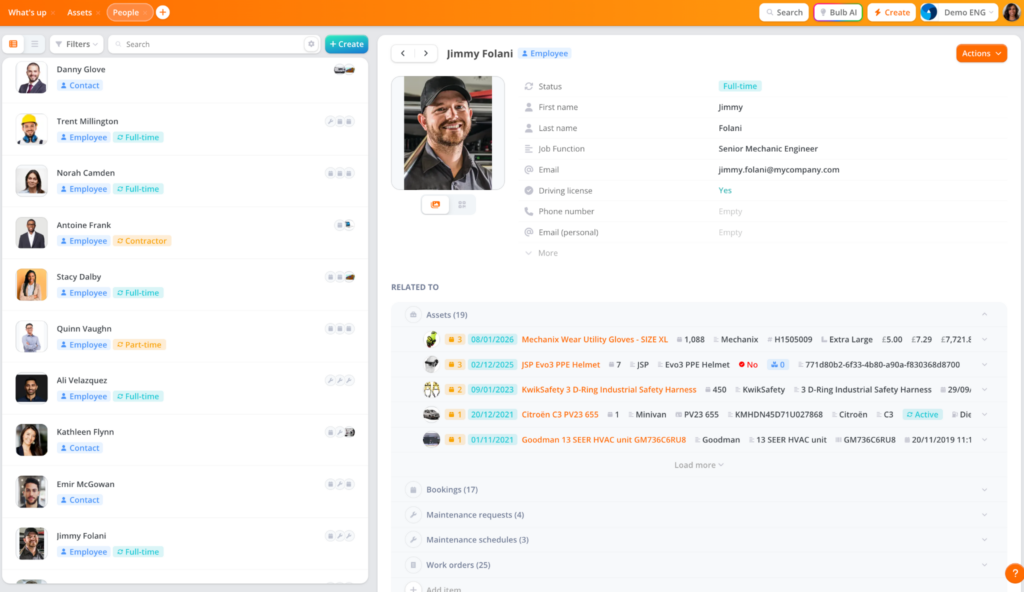
Each asset profile maintains a complete history of allocations, bookings, maintenance activities, service or financial contracts, and conversations, all visible to the right stakeholders.
Machine profile example:
Technician profile example:
What makes this collaboration secure is Bulbthings’ granular roles and permissions system. Permissions can be configured based on virtually any criteria, ensuring each user (whether an internal team member, a supplier, or a customer) sees only what they need and can only perform relevant actions.
This permission model makes it safe to bring dozens of external collaborators into the platform without compromising data security.
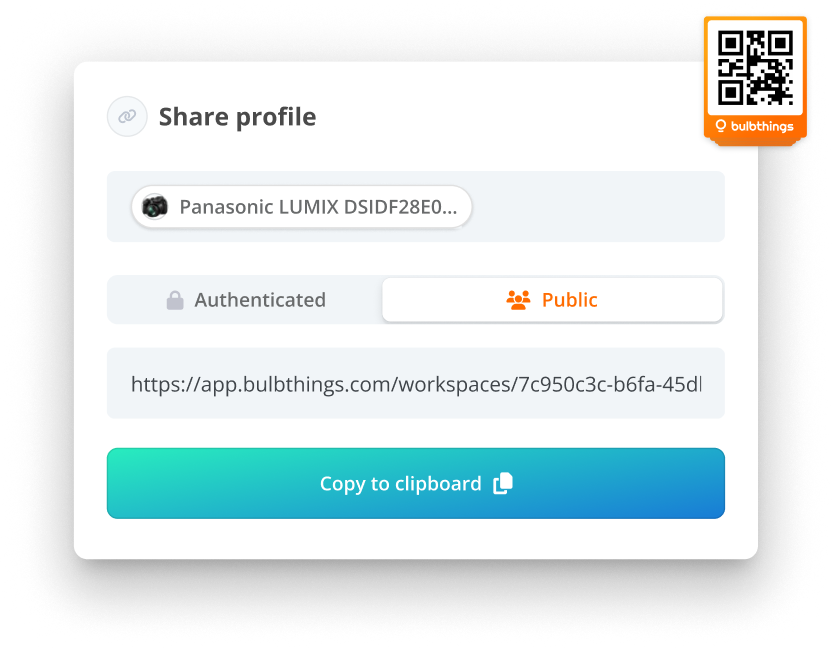
The platform also supports public data sharing via link or QR code. Office users can scan a public QR code to log issues without downloading an app, and work order information can be shared with suppliers via email links, removing friction from cross-organization coordination.
⚡ Bulbthings in Action: A facilities management company coordinates across 15 technicians, 5 office staff, 3 finance team members, and 50 facility managersand 2000 facility users.
Each stakeholder sees exactly what they need: technicians manage work orders on mobile, facility manager contractors submit maintenance requests and track work via QR code, facility users log issues via public QR code without an account, suppliers receive work order details via email links, and finance tracks costs and invoicing, all in a single workspace with granular permissions controlling visibility for each role.
“Wow! We tried 15 tools before yours guys… We are super impressed by how smart your design is!” — Ryan McCartney, BBC Broadcast Engineer
Bulb AI Agent: Full Natural Language Interaction Across the Entire Platform
UpKeep’s Nova AI runs on a schedule to audit parts data, reprioritize work orders, and surface insights, functioning primarily as a background automation tool focused on maintenance workflows.
Bulbthings’ Bulb AI, launched in November2 025, is a full AI agent that serves as the primary interaction method for the entire platform. Rather than automating narrow tasks in the background, Bulb AI lets users act across the complete range of platform functionality through natural language: create assets, make bookings, assign equipment, log maintenance requests, generate reports, and query data.
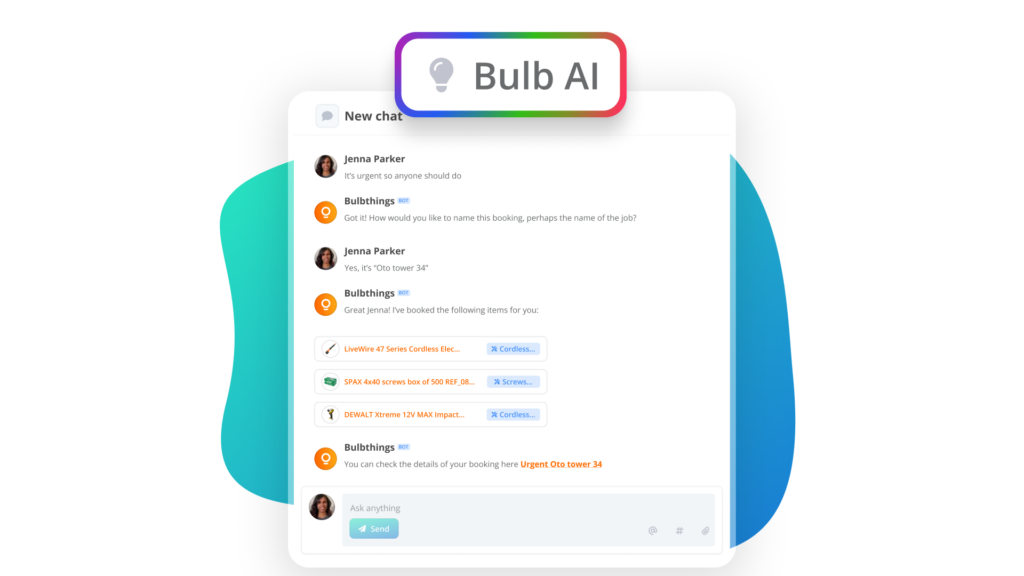
Source: Bulbthings
The AI also includes image recognition, so users can photograph an asset via the mobile app and have Bulb AI create it in the system automatically.
This matters for two reasons: instant onboarding (users don’t need to learn where to click, they just ask), and productivity gains on bulk operations across large asset volumes. For non-technical field staff, Bulb AI eliminates the learning curve. For managers, it turns multi-step reporting tasks into single-sentence requests.
⚡ Bulbthings in Action: A fleet manager types: “Show me all vehicles with maintenance costs exceeding £5,000 this year and upcoming service deadlines in the next 30 days.” Bulb AI instantly generates a filtered report with the relevant vehicles, their cost breakdowns, and upcoming maintenance schedules. No dashboard configuration, no report building, no exporting to Excel.
Activity-Based Pricing with Unlimited Users: Scale Your Team Without Per-Seat Costs
UpKeep charges $20 to $55+ per user per month depending on the tier, with features like workflow automation, API access, and SSO gated behind the quote-only Enterprise plan. For a 30-person maintenance team on Premium, that’s $19,800 per year in software costs alone, before implementation packages ($500 to $5,000+), IoT sensors, or additional modules.
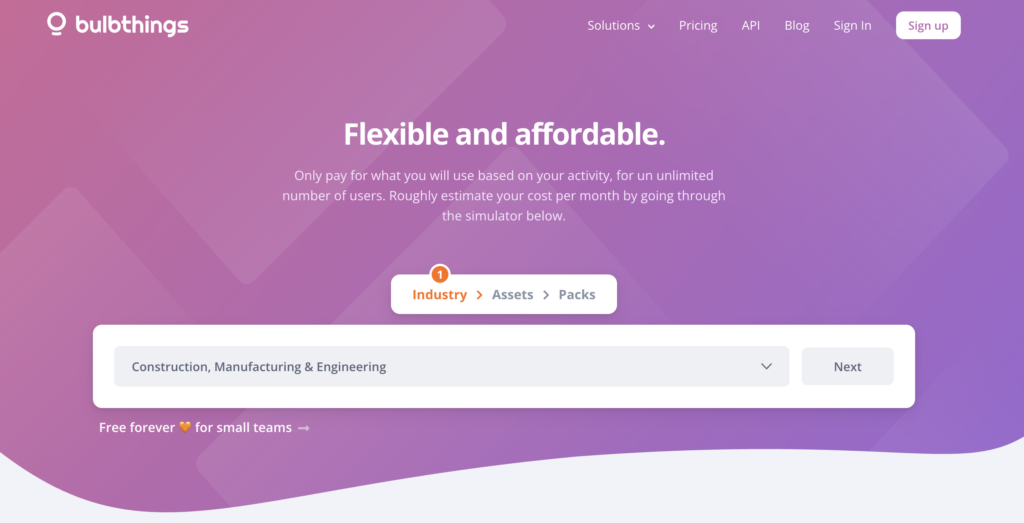
Bulbthings takes a different approach: activity-based pricing with unlimited users. The monthly fee is calculated based on your industry, number of assets managed, and feature packs selected, not the number of people who access the platform.
Source: Bulbthings
This is what makes the collaborative model practical: field workers, managers, suppliers, finance teams, customers, and external contractors can all use Bulbthings without adding per-seat costs. When collaboration with third parties is central to how you operate, per-seat pricing becomes a bottleneck. Activity-based pricing removes it.
Bulbthings offers flexibility with monthly payments and cancel-anytime option.
Bulbthings also offers a free plan supporting up to 100 assets for small teams to establish tracking workflows before committing to a paid plan.
⚡ Bulbthings in Action: A manufacturing company with 15 technicians, 5 office staff, 3 finance team members, and 20 external subcontractors who need to check equipment in and out, alongside machine maintenance, would require 15+ paid UpKeep seats (plus free requester accounts with limited functionality).
With Bulbthings, the entire organization (including subcontractors and suppliers) accesses the platform at a single activity-based price. As the team grows from 40 to 80 people, the software cost stays tied to asset volume and feature usage, not headcount.
Low-Code Workflow Automation: Digitalize Processes Without Development Resources
UpKeep added conditional logic in checklists only in November 2025 and gates workflow automation behind Enterprise pricing. Customizing operational processes beyond UpKeep’s built-in workflows typically requires API integrations or third-party tools.
Bulbthings was built as a low-code/no-code platform from the ground up, enabling organizations to customize workflows, validation processes, checklists, and forms without development resources.
The platform comes with off-the-shelf workflows by industry, so customers get pre-built solutions that work out of the box while retaining the flexibility to adapt them.
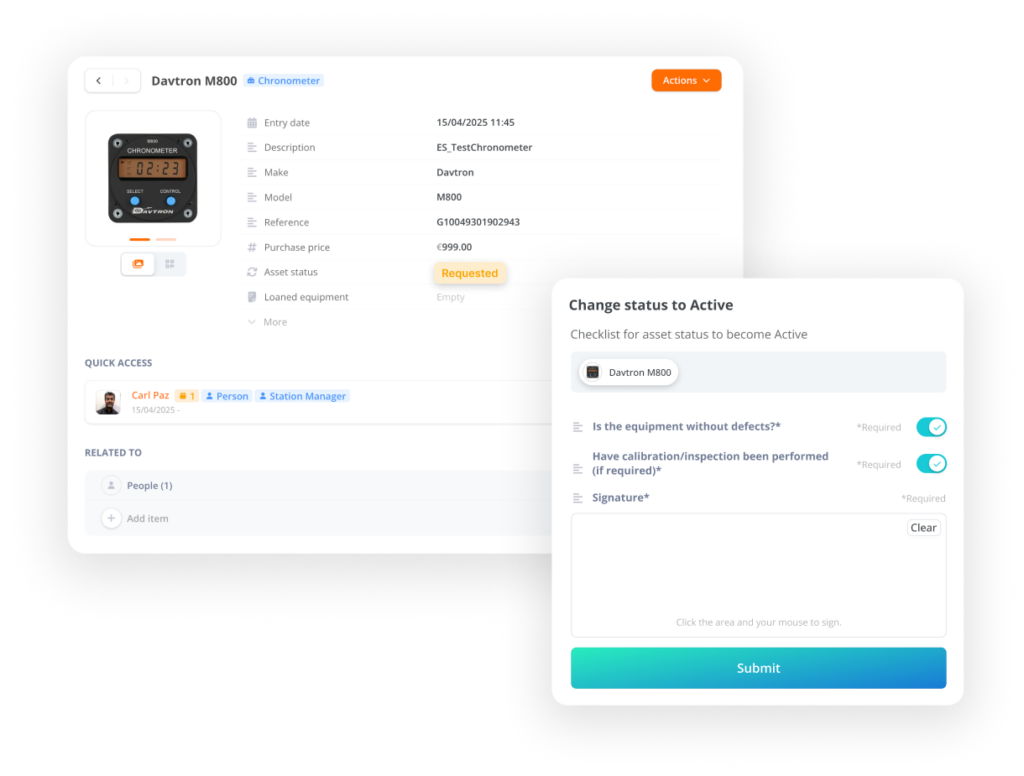
An AI workflow builder agent is in development that will let customers customize workflows entirely on their own through a visual interface.
This is particularly valuable for organizations with multi-step asset workflows that need to be digitalized (inspection sequences, approval chains, handoff protocols between teams, or regulatory compliance checks) where UpKeep’s workflow capabilities require Enterprise pricing to unlock.
James Fisher Renewables moved from Excel to Bulbthings because they needed parent-to-child asset hierarchies, warehouse-to-site movement tracking, and financial reporting in one place for a portfolio worth over £15 million in subsea spares.
🏅 NOTE: We looked into other multi-class asset management platforms and found that most either focus narrowly on CMMS (like UpKeep and MaintainX) or target enterprise EAM with heavy implementation requirements (like IBM Maximo or SAP PM).
Bulbthings occupies a distinct position: it delivers collaborative, multi-class asset management with the simplicity and speed-to-value of a modern SaaS tool, backed by a 5.0/5 rating on Capterra and 5.0/5 on GetApp for both ease of use and customer support.
Who Should Use Bulbthings?
Choose Bulbthings if:
- You need to coordinate asset workflows across internal teams, external suppliers, and customers, and need a collaborative platform with granular permissions that gives each stakeholder the right level of access (rather than limiting collaboration to work order comments).
- You are looking for a solution that allows quick onboarding to minimise training and change management risks.
- Your organization has many users who need platform access (field workers, office staff, finance teams, contractors, suppliers, customers) and per-seat pricing like UpKeep’s would make costs prohibitive as the team grows.
- You manage multiple classes of physical assets (equipment, vehicles, buildings, PPE, consumables) and need a single platform to manage them effectively.
- You have multi-step operational workflows that need to be digitalized and customized without development resources, and UpKeep’s workflow automation is either insufficient or locked behind Enterprise pricing.
Want to digitalize your asset workflows with collaborative features across teams, suppliers, and customers, all with unlimited users? Explore how Bulbthings can simplify your operations. Get started for free or request a demo.
2. MaintainX – Best Alternative for a Free CMMS Entry Point with Built-In Team Messaging
MaintainX is a mobile-first CMMS and Enterprise Asset Management platform serving over 13,000 global customers, from small maintenance teams to Fortune 500 manufacturers including Unilever, DHL, Duracell, and McDonald’s.
What sets MaintainX apart is its permanently free Basic plan with unlimited work orders, unlimited asset entries, and unlimited requester users, combined with built-in real-time team messaging. Its key capabilities include:
- Free forever Basic plan with unlimited work orders and asset records at zero cost
- Built-in real-time team messaging with @mentions, threaded conversations, and file attachments
- AI-powered procedure generation from uploaded PDF manuals, photos, or voice prompts via MaintainX CoPilot
- Full offline mobile mode on all plans, including the free tier
- Workload-based scheduling with AI-generated time estimates from historical data
Why Choose MaintainX Over UpKeep for Zero-Cost CMMS Adoption?
MaintainX stands out in the following areas:
Permanently Free Tier vs. Paid-Only Entry
MaintainX’s Basic plan is free forever with no time limit or credit card requirement. It includes unlimited work orders, unlimited asset records, unlimited requester users, and real-time messaging. While it restricts some features (5 work orders with images per month, 2 active repeating work orders), a small team can digitize their entire operation at zero cost.
UpKeep gates all functionality behind a $20/user/month Essential minimum, meaning a five-person team faces a $1,200 annual commitment before anyone can test the software in a real environment.
Native Team Messaging vs. Work Order Comments
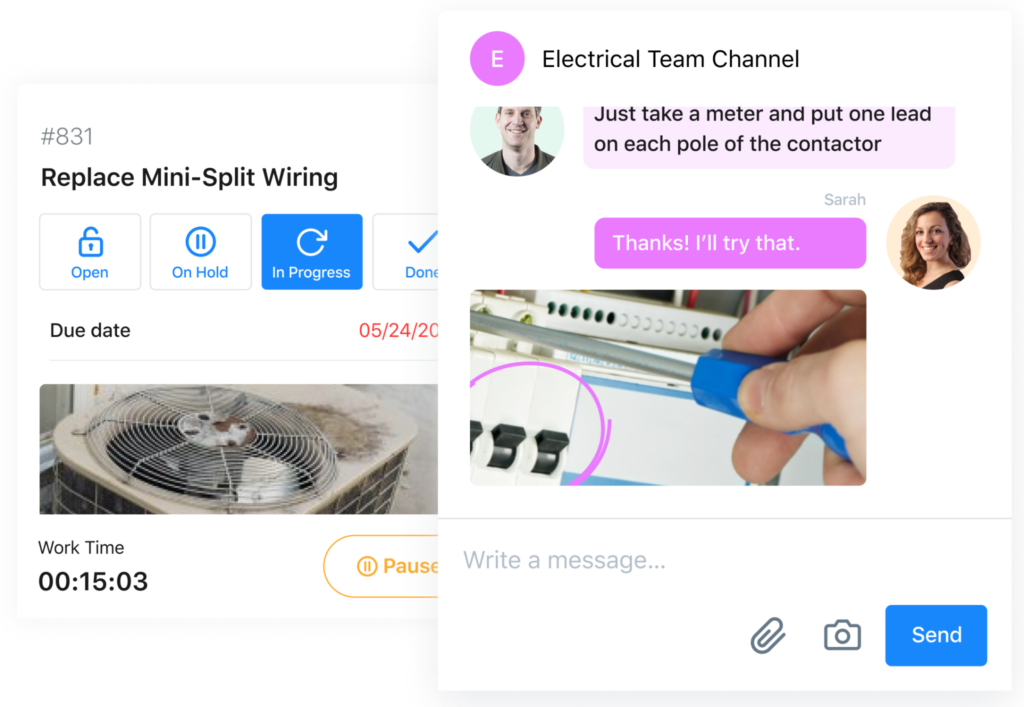
UpKeep limits internal communication to single-threaded work order comment logs with no cross-work-order visibility or @mention functionality. MaintainX embeds real-time messaging directly within the platform with threaded conversations, @mentions, photo attachments, and persistent searchable history.
Source: MaintainX Real-time Messages
Teams can create location-based or role-based channels for ongoing coordination beyond individual work orders, replacing WhatsApp, Slack, or text messages for maintenance communication.
Full Offline Mode on Every Plan
MaintainX provides native offline mode across all plans starting at the Basic (free) tier. Technicians can view work orders, complete checklists, attach photos, and log parts usage without network connectivity.
UpKeep gates offline mode behind the Professional tier, meaning Essential and Premium users lose functionality when connectivity drops in basements, rural sites, or RF-shielded environments.
🏅 NOTE: We also evaluated free-tier alternatives such as Limble’s Basic plan and Fiix’s free tier. While both offer solid core functionality, MaintainX provides the most complete free plan: unlimited work orders, unlimited assets, unlimited requesters, built-in messaging, and full REST API access even on the free tier.
MaintainX Pricing
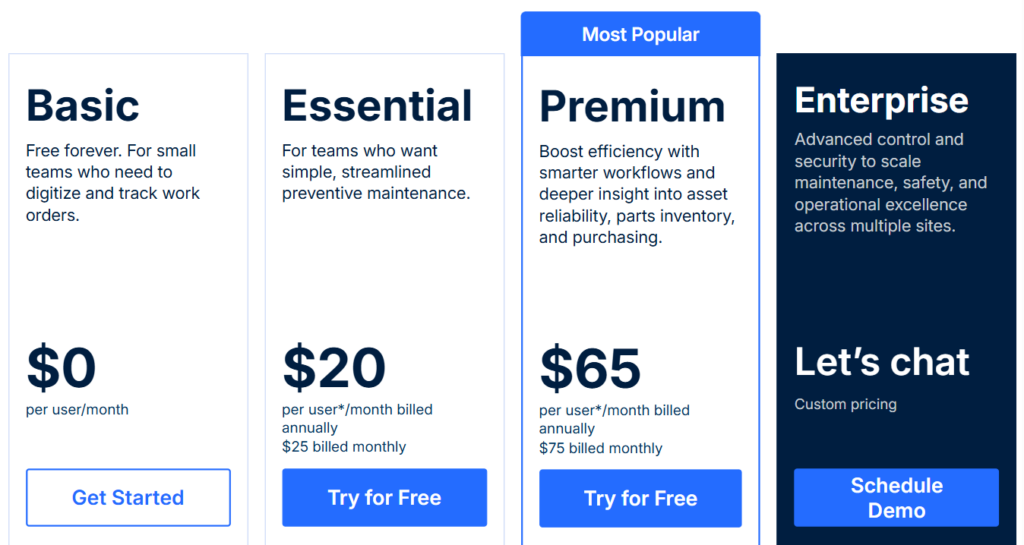
MaintainX offers four pricing tiers:
- Basic: $0/user/month (free forever) with unlimited work orders, unlimited assets, real-time messaging, and mobile app with offline mode. Limited to 5 work orders with images/month and 2 active repeating PMs.
- Essential: $20/user/month (annual) adds unlimited images, unlimited repeating PMs, and 3-month analytics.
- Premium: $65/user/month (annual) adds meter-based maintenance, parts inventory, PO management, time tracking, and open REST API.
- Enterprise: Custom pricing adds asset health insights, resource planning, IoT integrations, SSO, and full AI assistant.
Who Should Use MaintainX?
Choose MaintainX if:
- Your maintenance budget is constrained and you need a free CMMS with unlimited work orders and asset tracking to demonstrate value before requesting budget approval.
- Your technicians work in areas with unreliable connectivity and need full offline mobile access without paying for a higher-tier plan.
- Your team currently juggles WhatsApp, Slack, and text messages alongside the CMMS, and you want built-in messaging where operational context lives alongside work orders and asset records.
3. Fiix – Best Alternative for Enterprise Industrial Operations
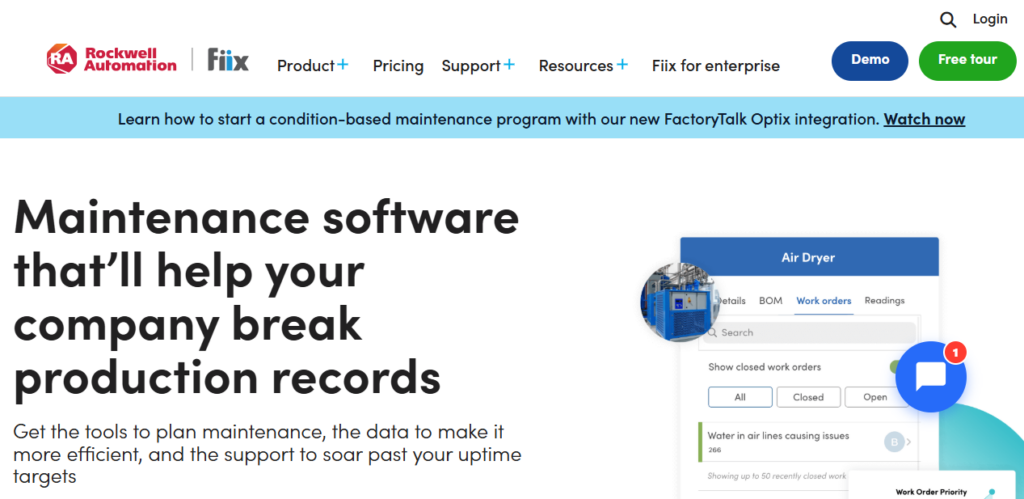
Fiix is a cloud-based CMMS owned by Rockwell Automation that bridges maintenance management and industrial automation infrastructure. Serving over 4,100 maintenance teams across 100+ countries, Fiix was named a Leader in the IDC MarketScape: Worldwide SaaS CMMS Application 2024 Vendor Assessment. Its key capabilities include:
- Rockwell Automation ecosystem integration for native connectivity with PLCs, SCADA systems, and FactoryTalk infrastructure
- Fiix Foresight AI with prescriptive maintenance that turns failure predictions into detailed repair instructions
- Drag-and-drop asset hierarchy supporting multi-level parent-child structures (regions, sites, facilities, equipment, tools, parts)
- Integration Hub connecting to SAP, Oracle NetSuite, Microsoft Dynamics 365, and thousands of other endpoints
- 50+ pre-built report templates with a custom report writer and real-time analytics dashboards
Why Choose Fiix Over UpKeep for Enterprise Industrial Operations?
Fiix stands out in the following areas:
Industrial Automation Ecosystem Integration
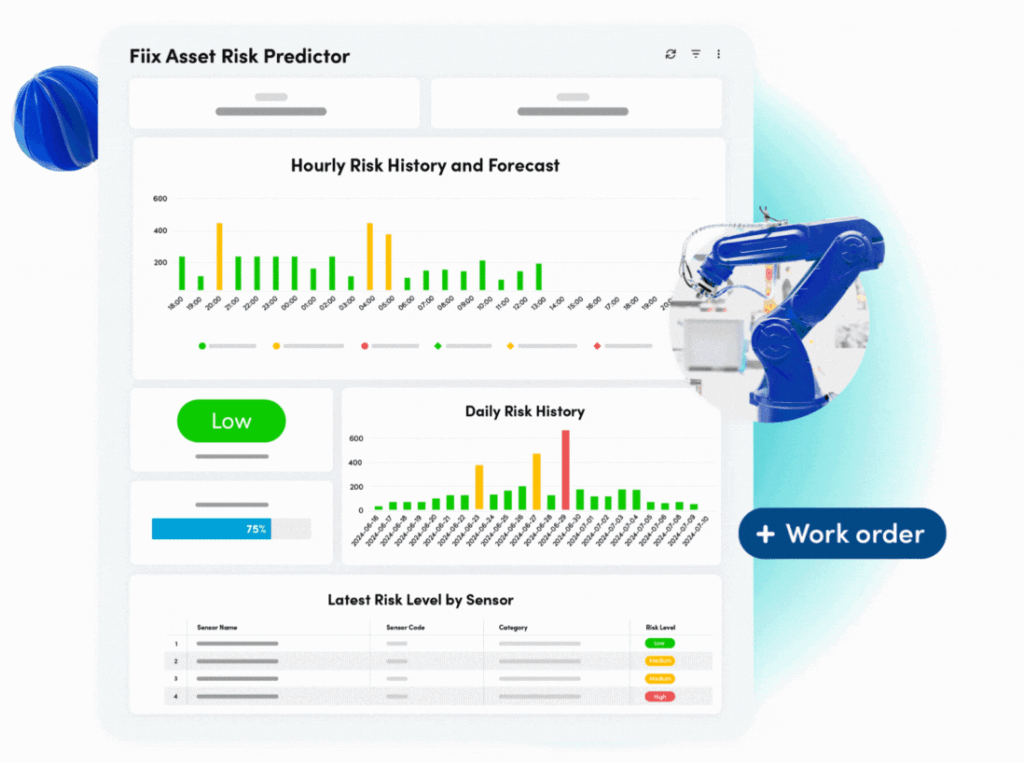
Where UpKeep positions Edge IoT sensors as a separate add-on module, Fiix provides industrial-grade predictive maintenance through Fiix Asset Risk Predictor and FactoryTalk Optix, connecting natively with all major PLC brands, MES systems, and protocols like MQTT and OPC UA.
For organizations already running Rockwell Automation hardware, Fiix is the only CMMS that taps directly into the existing operational technology stack..
AI-Powered Prescriptive Work Orders
While UpKeep’s Nova AI surfaces insights and automates administrative tasks, Fiix’s GenAI Prescriptive Maintenance goes further: when a failure prediction occurs, the AI generates a complete, step-by-step work order drawn from the organization’s own maintenance history. Technicians receive ready-to-execute instructions rather than alerts that still require manual planning.
Source: Fiix GenAI
Enterprise-Scale Asset Hierarchy and Reporting
UpKeep users frequently cite asset hierarchy limitations for deeply nested equipment structures. Fiix supports multi-level drag-and-drop hierarchies with custom categories and batch scheduling. Combined with 50+ report templates, scheduled report delivery, and drill-down analytics, Fiix addresses the reporting friction that UpKeep users consistently flag.
🏅 NOTE: We also evaluated IBM Maximo and Brightly Asset Essentials for this enterprise industrial archetype. While both are strong enterprise EAM platforms, Fiix offers the tightest industrial automation integration for teams running Rockwell Automation equipment, combined with AI capabilities deployed across 4,100+ maintenance teams in 100+ countries.
Fiix Pricing
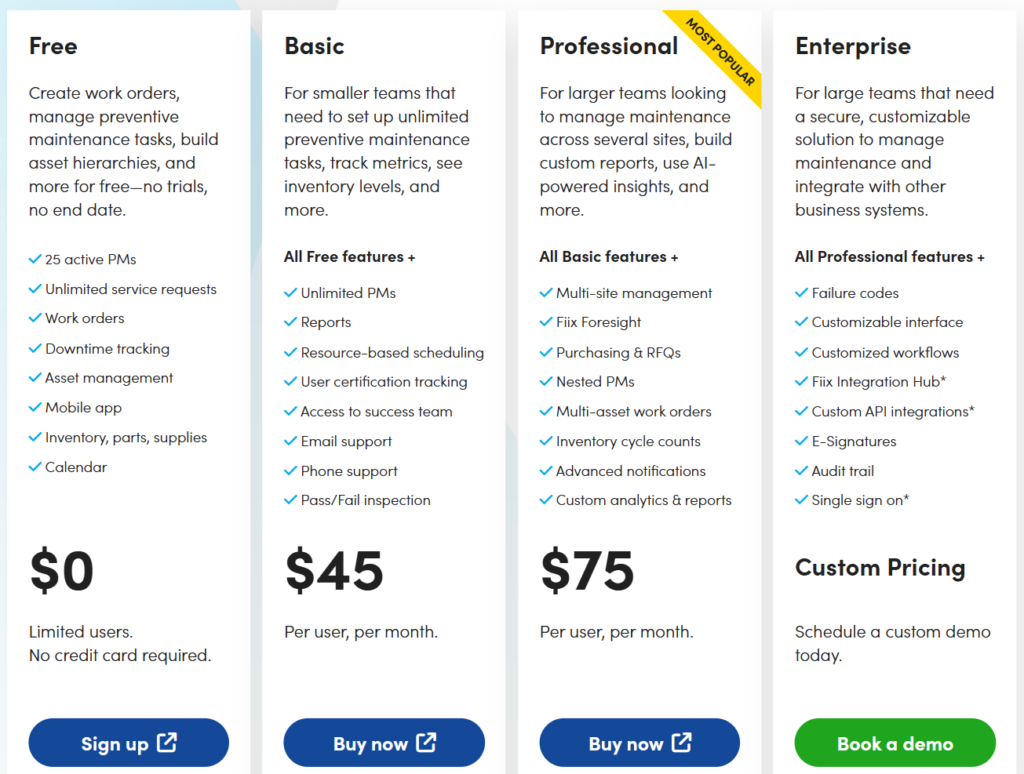
Fiix offers four tiers:
- Free: $0/user/month with up to 25 active PMs, unlimited work orders, and mobile app access.
- Basic: $45/user/month adds unlimited PMs, standard reports, and email/phone support.
- Professional: $75/user/month (most popular) adds multi-site management, Fiix Foresight AI, purchasing/RFQ management, and custom analytics.
- Enterprise: Custom pricing for total productive maintenance with dedicated account management.
Who Should Use Fiix?
Choose Fiix if:
- Your organization already runs Rockwell Automation equipment and needs native integration into the FactoryTalk ecosystem without custom middleware development.
- You need AI that writes detailed work orders with step-by-step repair instructions, not just alerts, to help less experienced technicians handle complex repairs.
- You manage deeply nested asset hierarchies across multiple sites and need structural flexibility that UpKeep’s flatter architecture struggles to accommodate.
4. Brightly Asset Essentials – Best Alternative for Capital Planning and Compliance-Driven Organizations
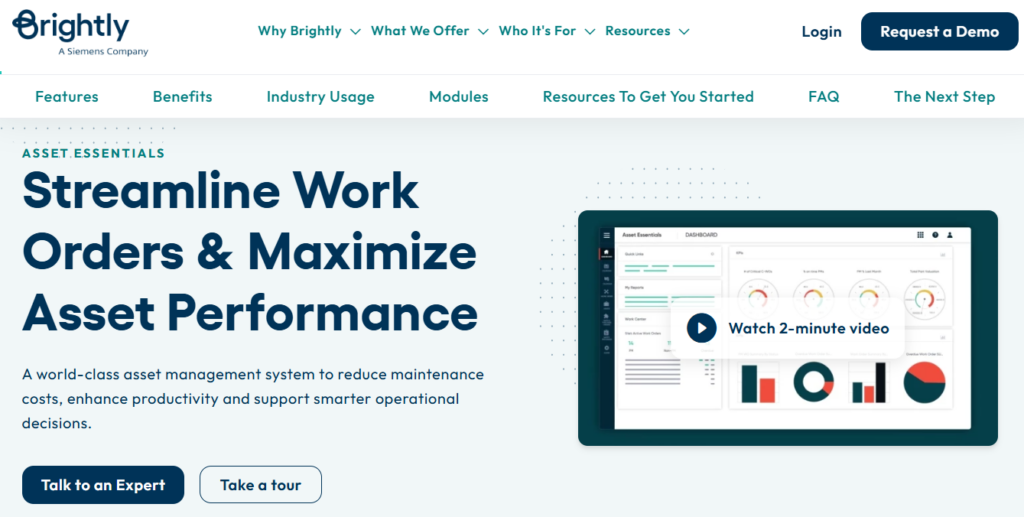
Brightly Asset Essentials is an Enterprise Asset Management platform owned by Siemens, serving over 12,000 organizations managing more than 49 million assets globally. Following a $1.575 billion acquisition by Siemens in August 2022, Brightly extends well beyond day-to-day work orders into capital planning, infrastructure investment analysis, and regulatory compliance documentation. Its key capabilities include:
- 100+ predefined reports, dashboards, and KPIs delivering operational and budget insights from day one
- Full asset lifecycle management from acquisition through disposal, including capital planning and budget forecasting
- Predictive maintenance with IoT via Smart Assets for Asset Essentials for condition-based monitoring
- Free mobile app with offline capability included at no additional cost
- Data Share module with native connectors to Power BI, Tableau, Snowflake, and MS SQL Server
Why Choose Brightly Over UpKeep for Capital Planning and Compliance?
Brightly Asset Essentials stands out in the following areas:
Out-of-the-Box Reporting That Works Without Custom Development
UpKeep users consistently cite reporting as a pain point across SoftwareAdvice and Capterra reviews. Brightly ships with over 100 predefined reports including predictive analytics, industry benchmarking, and lifecycle cost analysis.
Boston Public Schools cut monthly data prep time from days to under an hour using the Data Share module.
Full Asset Lifecycle and Capital Planning
UpKeep’s data model is optimized for operational maintenance: create work orders, assign techs, log parts, close jobs. Brightly tracks assets across their full lifecycle from acquisition to disposal, with capital planning and long-term infrastructure investment analysis built in.
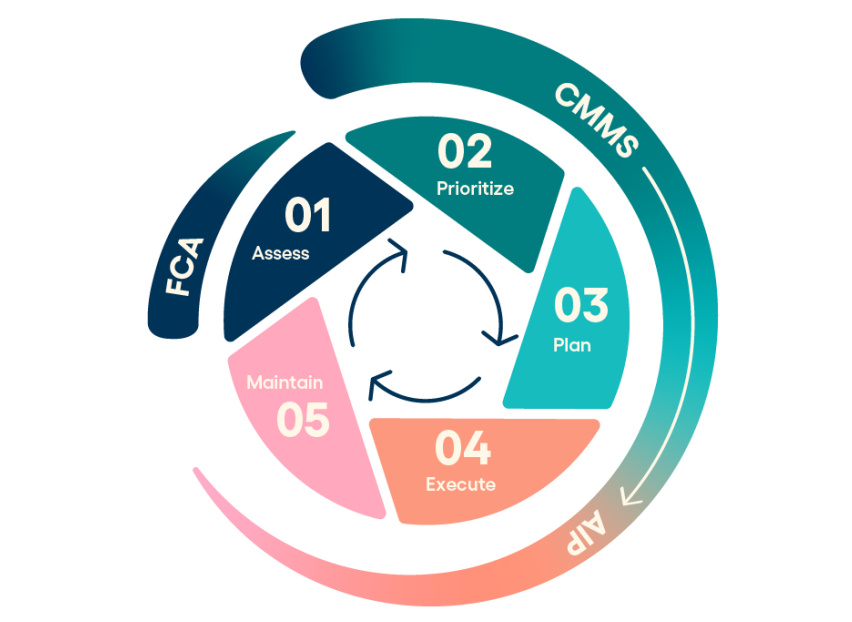
Source: Brightly Lifecycle
Built for Institutional Compliance
Brightly is built for education, government, manufacturing, healthcare, and senior living, with a 20-year track record in institutional verticals where maintenance data must withstand external audit from regulators, insurers, and elected officials.
🏅 NOTE: We also evaluated IBM Maximo and SAP Asset Manager for this archetype. While both offer deeper ERP integration, Brightly delivers enterprise-scale breadth with a more accessible learning curve, and the Siemens acquisition provides long-term investment confidence without the implementation overhead of legacy enterprise platforms.
Brightly Asset Essentials Pricing
Brightly Asset Essentials uses a quote-based, contract-driven pricing model. All pricing is delivered through a negotiated order form with entitlement-based licensing. Prospective buyers should expect a demo-led sales process.
Add-on modules include Smart Assets (IoT), Data Share (analytics), and PartExpress (inventory workflows), each priced separately. Implementation services are billed on a time-incurred basis.
Who Should Use Brightly Asset Essentials?
Choose Brightly Asset Essentials if:
- You need audit-grade, legally defensible asset records for bond proposals, insurance claims, or regulatory compliance.
- You’re evaluating not just maintenance management but capital planning and asset investment strategy that connects daily work orders with long-term infrastructure forecasting.
- You’re in education, government, healthcare, or senior living and need documented compliance use cases and vendor references from your specific vertical.
5. Limble – Best Alternative for a Focused, Pure-Play CMMS
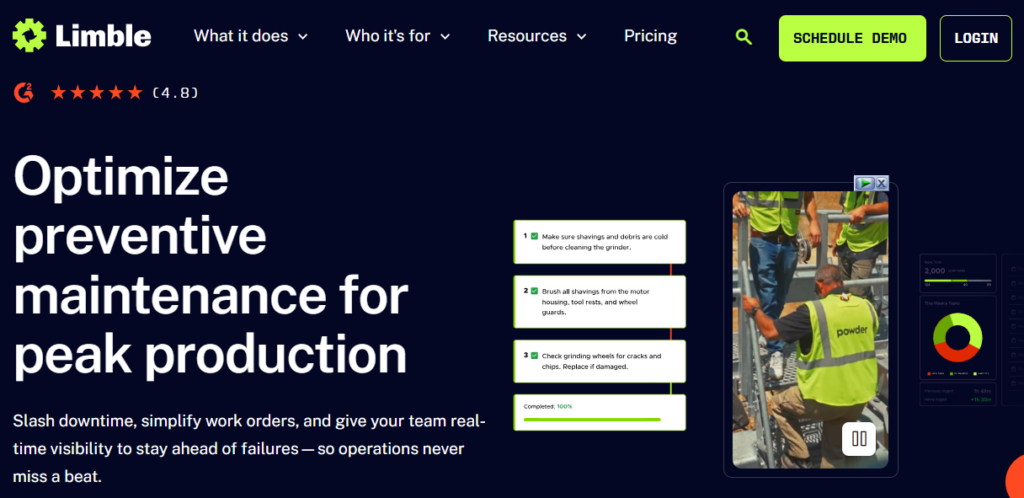
Limble CMMS is a cloud-based maintenance management system that has positioned itself as a specialist pure-play CMMS, offering strong functionality in work orders, preventive maintenance, asset tracking, and parts inventory without expanding into adjacent categories.
Its key capabilities include:
- Intuitive interface with a 4.8/5 ease-of-use score across major review platforms
- 30+ language support for global operations with multilingual teams
- Sophisticated PM scheduling with calendar-based, meter-based, and threshold-based triggers featuring conditional logic
- SOC 2 Type II certified with 21 CFR Part 11 compliance at Enterprise tier
Why Choose Limble Over UpKeep for Focused Maintenance Management?
Limble stands out in the following areas:
All-Inclusive Pricing
Limble bundles implementation, training, and 24/7 US-based support into every subscription. UpKeep structures implementation as optional paid packages ($500 to $5,000+) layered on top of the subscription. A team needing UpKeep Premium ($55/user) plus Quickstart Implementation ($1,500) pays more in year one than comparable Limble pricing with all services included.
Fastest Implementation in the Category
Recognized with G2 badges for Fastest Implementation in Enterprise, Limble customers commonly report reaching operational value within 3 weeks. UpKeep’s broader platform (CMMS, EHS, Studio, Edge, Fleet, LMS) introduces configuration overhead that Limble’s focused feature set avoids.
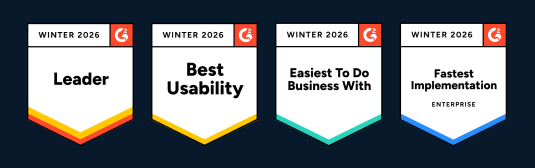
Source: Limble G2 Badges
Sophisticated PM Scheduling Without Enterprise Pricing
Limble’s PM engine supports multi-trigger logic, seasonal restrictions, and completion-based recalculation starting at Standard tier. UpKeep shipped conditional logic in checklists only in November 2025 and gates workflow automation behind Enterprise pricing. The AI-powered PM Builder also generates PM templates from uploaded manufacturer manuals.
🏅 NOTE: We also evaluated Click Maint and Coast for the focused CMMS specialist archetype. Click Maint offers solid functionality at competitive pricing, and Coast provides a clean mobile-first experience. Limble stands out for its usability, PM scheduling depth at mid-tier pricing, and proven enterprise scalability with customers including Unilever, DHL, McDonald’s, and Nike.
Limble Pricing
Limble uses an annual subscription model:
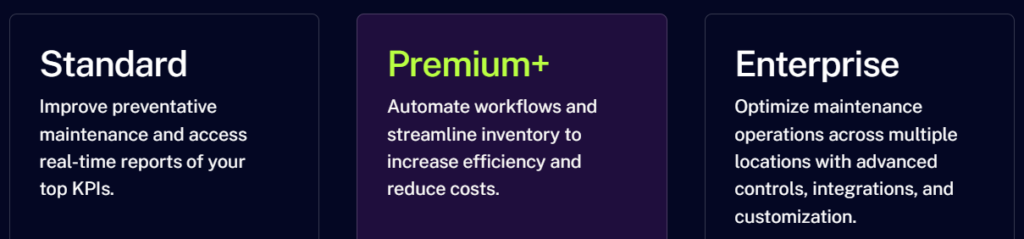
- Standard: Unlimited assets, work orders, custom dashboards, and 24/7 support with implementation included.
- Premium+: Pricing via calculator or sales. Adds offline mode, spare parts management, vendor/PO management, meter-based PM, open REST API, and dedicated CSM.
- Enterprise: Custom quote. Adds multi-location tools, custom roles, inventory cycle counts, 21 CFR Part 11 compliance, SSO, and ERP/IoT integrations.
Who Should Use Limble?
Choose Limble if:
- You need a specialist CMMS that does maintenance management well without the overhead of managing multiple integrated modules.
- You’re managing maintenance across multiple countries with multilingual teams and need native 20+ language support.
- Cost predictability matters more than module breadth, and you want implementation, training, and support bundled into an all-inclusive price.
6. Click Maint – Best Alternative for Small Teams Needing Simple, Transparent Pricing
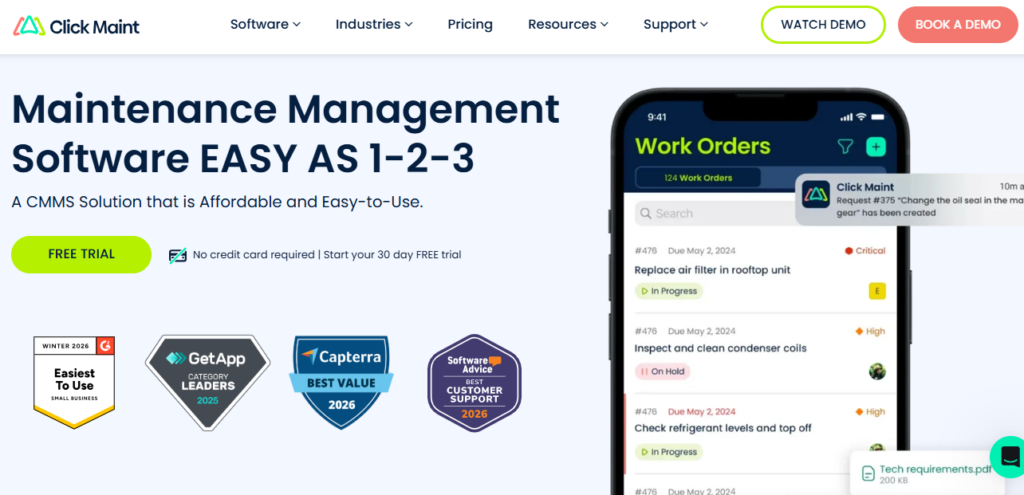
Click Maint is a cloud-based CMMS that offers a single Professional Plan at a flat rate, deliberately countering the multi-tier pricing structures that characterize most CMMS platforms.
Founded in 2023 to address the reality that only 6% of CMMS users utilize all available functionality and 61% of maintenance managers struggle with implementations, Click Maint delivers a complete but streamlined feature set designed to get small teams operational within one to two days. Its key capabilities include:
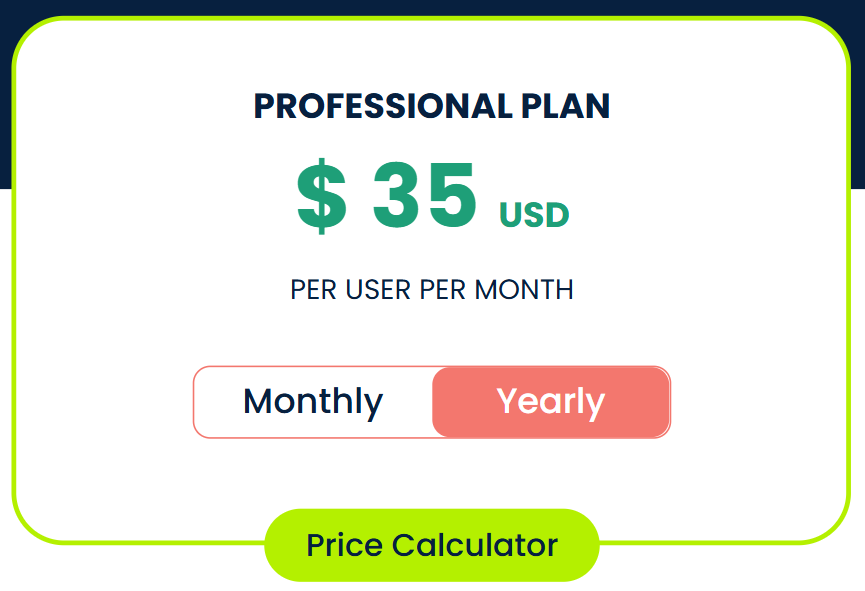
- $35/user/month flat pricing with no feature tiers, no setup fees, and no hidden implementation charges
- Operational within 1-2 days with Quick Start onboarding for small teams
- Unlimited requesters and QR code request portals included in the single plan
- Vendor management integrated into work orders and parts records
- MTTR/MTBF auto-calculation and KPI dashboards with standard reporting
Why Choose Click Maint Over UpKeep for Small Teams?
Click Maint stands out in the following areas:
Single-Plan Pricing vs. Four-Tier Feature Gating
UpKeep spans four tiers where critical capabilities (external request portal, offline mode, workflow automation, API, SSO) are distributed across increasingly expensive plans. Click Maint eliminates this: every feature ships in one plan at $35/user/month. A 10-person team calculates their annual cost in seconds: $4,200/year with no tier upgrades, module add-ons, or sales negotiation.
Fastest Time-to-Value for Small Teams
Click Maint’s Quick Start onboarding puts 1-5 user teams fully operational within 15 days, with the platform usable within days. UpKeep’s broader platform requires decisions about which modules to activate, how to configure workflows, and which implementation package to purchase ($500-$5,000+).
Complete Feature Access Without Enterprise Barriers
Click Maint includes capabilities that UpKeep gates behind Enterprise pricing: procedures with enforced completion and signature capture, REST API access, SSO via Google SAML and Microsoft Entra ID, and floor plans for spatial asset visualization. All at $35/user/month.
Source: Click Maint API
🏅 NOTE: We also evaluated MaintainX and Coast for this archetype. While MaintainX’s free tier is excellent for zero-budget teams, Click Maint offers the most accessible paid CMMS for small teams who want a complete feature set without navigating tier structures or enterprise sales cycles.
Click Maint Pricing
Click Maint offers a single plan:
- Professional Plan: $35/user/month (annual) or $42/user/month (monthly). Includes all features: work orders, preventive maintenance, assets, locations, inventory, vendor management, QR codes, mobile app, reports/KPIs, and customer support. Requesters and vendors are free and unlimited.
- 30-day free trial with no credit card required and full feature access.
Who Should Use Click Maint?
Choose Click Maint if:
- You are a small maintenance team (1-10 technicians) currently managing work on paper or spreadsheets and need a complete CMMS operational within days, not weeks.
- Pricing transparency and budget predictability are non-negotiable, and you cannot navigate a four-tier pricing ladder with quote-only upper tiers.
- Your organization is a non-profit, municipality, educational institution, or small healthcare facility where enterprise CMMS pricing creates a hard budget barrier.
7. TRACTIAN – Best Alternative for AI-Powered Predictive Maintenance with Integrated Sensors
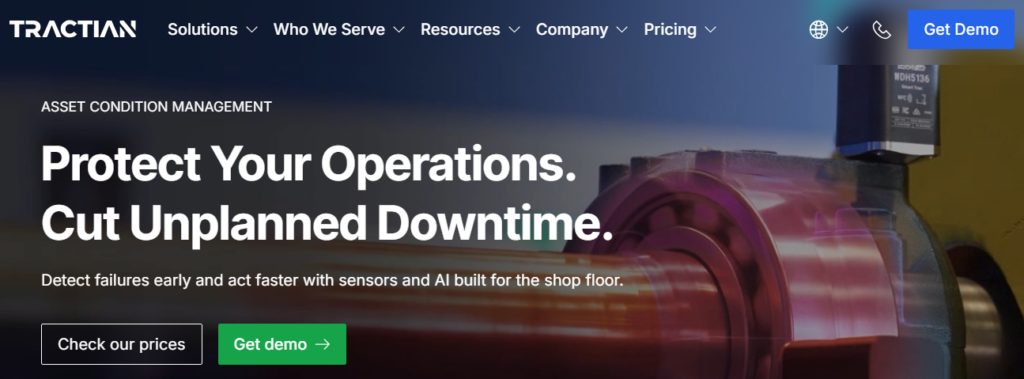
TRACTIAN is an industrial AI/IoT platform that combines proprietary condition monitoring sensor hardware, AI-powered failure diagnostics, and a full CMMS in a single integrated system.
Its key capabilities include:
- Smart Trac Ultra sensors combining triaxial vibration (0-64,000 Hz), ultrasound (up to 200 kHz), magnetometer RPM, and temperature in a single device
- AI Auto Diagnosis with a 70,000+ bearing library detecting 35+ distinct fault modes with severity scoring
- Asset GPT translating sensor data into plain-language diagnostics and repair recommendations
- AI-generated SOPs from historical maintenance data and equipment manuals
- Unified CMMS and condition monitoring where sensor-detected faults automatically generate work orders with embedded diagnostic guidance
Why Choose TRACTIAN Over UpKeep for Predictive Maintenance?
TRACTIAN stands out in the following areas:
Integrated Hardware and AI vs. Third-Party Sensor Add-Ons
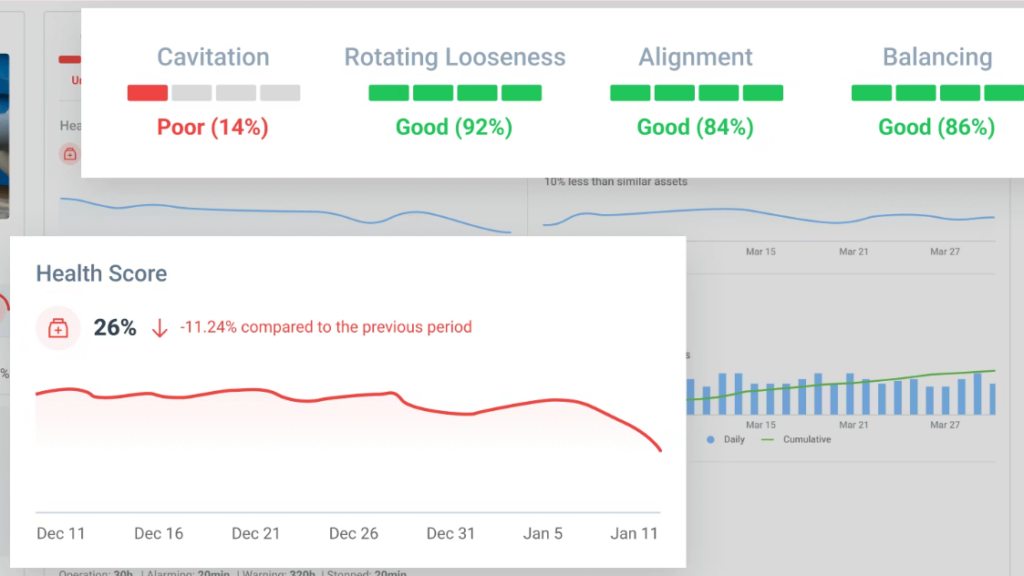
UpKeep’s Edge sensors are threshold monitors: you define high/low limits, and alerts fire when readings cross those boundaries. TRACTIAN’s sensors feed proprietary AI models trained on millions of machine-hours of data.
When the AI detects a developing fault, it identifies the specific failure mode (bearing outer race erosion, misalignment, cavitation), scores severity, estimates time-to-failure, and recommends repair actions. If you don’t know what vibration level indicates a problem, UpKeep Edge won’t tell you. TRACTIAN’s AI provides that expertise as part of the platform.
Equipment-Specific AI Diagnostics vs. Administrative AI
UpKeep’s Nova AI automates administrative tasks: auditing parts, reprioritizing work orders, transcribing voice notes. TRACTIAN’s AI operates at the asset health layer, performing the role of a Level II/III vibration analyst by continuously analyzing incoming sensor streams against known fault frequency patterns.
Source: TRACTIAN Asset Health
Nova helps you manage work orders faster; TRACTIAN helps you predict and prevent equipment failures.
Full-Service Industrial Implementation
TRACTIAN’s offering includes training, support, installation, and integration in the subscription. TRACTIAN engineers physically install sensors, configure AI baselines, and train teams on-site, reducing implementation risk for organizations managing critical rotating equipment.
🏅 NOTE: We also evaluated Fracttal One and SuperCMMS for this predictive maintenance archetype. TRACTIAN offers the tightest integration of proprietary sensor hardware, AI diagnostics, and CMMS workflow management, eliminating the multi-vendor friction that typically undermines predictive maintenance initiatives.
TRACTIAN Pricing
TRACTIAN uses a per-seat annual subscription:
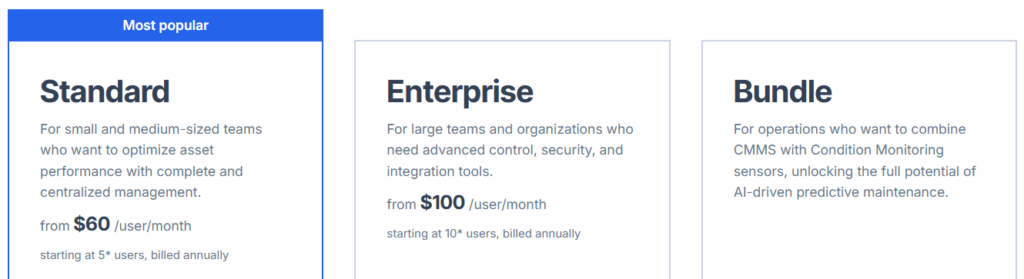
- CMMS Standard: From $60/user/month (minimum 5 users, billed annually). Includes Tractian AI, unlimited assets, unlimited requesters, and full CMMS features.
- CMMS Enterprise: From $100/user/month (minimum 10 users). Adds custom entities, SSO, Power BI Connector, and ERP integration.
- Bundle (CMMS + Sensors): Contact sales. Includes proprietary Smart Trac hardware, patented failure detection AI, and automated failure reports.
A free sandbox environment is available for CMMS evaluation.
Who Should Use TRACTIAN?
Choose TRACTIAN if:
- Your operations depend on critical rotating equipment (motors, pumps, compressors, gearboxes) where unplanned downtime costs thousands per hour.
- You need to transition from reactive to predictive maintenance but lack in-house vibration analysis expertise; TRACTIAN’s AI provides diagnostic capabilities equivalent to a specialized vibration analyst.
- You prefer an integrated vendor for condition monitoring rather than managing separate sensor, analytics, and CMMS relationships.
The Final Verdict
While UpKeep excels as a mobile-first CMMS with a strong AI agent and expanding module ecosystem, different operational requirements call for specialized solutions. Based on our research, here are the best alternatives:
- Bulbthings for collaborative, inventory and asset management with unlimited users, digitalizing workflows across teams, suppliers, and customers with Bulb AI, low-code automation, and activity-based (unlimited users) pricing.
- MaintainX for zero-cost CMMS entry with built-in team messaging and full offline mobile access on every plan
- Fiix for enterprise industrial operations with Rockwell Automation integration and AI-powered prescriptive work orders
- Brightly Asset Essentials for capital planning, compliance documentation, and institutional asset management backed by Siemens
- Limble for focused, pure-play CMMS with all-inclusive pricing, 30+ language support, and the fastest implementation in the category
- Click Maint for small teams needing a complete CMMS at a flat $35/user/month with no feature tiers or hidden costs
- TRACTIAN for AI-native predictive maintenance with integrated condition monitoring hardware and 35+ fault mode detection
You don’t have to choose between UpKeep and these alternatives exclusively. Many organizations use UpKeep alongside specialized tools. Consider your specific asset types, team size, budget constraints, and growth plans when deciding which solution works best for you.
Want to digitalize your asset workflows with collaborative features across teams, suppliers, and customers, all with unlimited users? Explore how Bulbthings consolidates inventory, maintenance, fleet, and field services with Bulb AI and low-code/no-code workflow automation. Get started for free or request a demo to see it in action.
UpKeep Alternatives FAQ
Why do businesses look for UpKeep alternatives?
UpKeep is a strong mobile-first CMMS, but businesses often look elsewhere when they need broader asset lifecycle management beyond maintenance, when per-seat pricing becomes costly for large teams, when features like workflow automation and API access are only available on quote-only Enterprise plans, or when reporting requires more configuration than expected.
Teams with specific needs around capital planning, industrial automation integration, collaborative multi-stakeholder workflows, or predictive maintenance hardware may also find specialized tools better suited to their requirements.
What is the best overall UpKeep alternative?
There is no single best alternative because UpKeep covers multiple functions. Bulbthings is the top choice for organizations that need collaborative, multi-class asset management with unlimited users, particularly mid-sized companies managing diverse physical assets across teams, suppliers, and customers.
MaintainX leads for teams needing a free entry point with built-in communication. Fiix is the strongest option for enterprise industrial operations with Rockwell Automation integration.
Is there a free alternative to UpKeep?
Yes. MaintainX offers a permanently free Basic plan with unlimited work orders, unlimited asset records, unlimited requester users, real-time messaging, and offline mobile access. Fiix provides a free tier with up to 25 active preventive maintenance tasks and unlimited work orders.
Bulbthings offers a free plan for small teams managing up to approximately 100 assets. Click Maint provides a 30-day free trial with full feature access.
Which UpKeep alternative is best for small teams on a budget?
Click Maint offers the most transparent pricing for small teams at $35/user/month with no feature tiers, no setup fees, and operational readiness within days. MaintainX’s free Basic plan is ideal if the budget is zero.
Bulbthings’ activity-based pricing with unlimited users can be more cost-effective than per-seat models when teams include field workers, managers, contractors, suppliers, and customers who all need platform access.
How does UpKeep compare to Bulbthings for asset management?
UpKeep is a CMMS-first platform that handles maintenance work orders, preventive maintenance, and parts inventory well, with IoT sensors, EHS, and fleet as separate add-on modules.
Bulbthings is a collaborative asset management platform that digitalizes asset workflows across internal teams, suppliers, and customers, covering multiple asset classes (equipment, vehicles, buildings, IT assets, and consumables) in a single workspace with Bulb AI for natural language interaction and low-code workflow automation.
The key structural differences: UpKeep charges per user per month, while Bulbthings uses activity-based pricing with unlimited users; Bulbthings prioritizes cross-stakeholder collaboration with granular permissions, while UpKeep centers on the maintenance team.
Which alternative works best for large manufacturing operations?
Fiix is built for enterprise industrial environments, offering native Rockwell Automation integration, AI-powered prescriptive work orders, and a multi-level asset hierarchy supporting parent-child equipment structures across multiple sites.
TRACTIAN is the strongest choice when the primary goal is shifting from reactive to predictive maintenance using integrated condition monitoring hardware with AI diagnostics for rotating equipment.
Is it difficult to migrate from UpKeep to one of these alternatives?
Migration difficulty depends on what you use UpKeep for. Replacing a single function like work order management with a specialist CMMS like Limble or Click Maint is straightforward, and both platforms include implementation support.
Moving to a broader platform like Bulbthings or Brightly that covers additional asset management functions requires more data migration planning but can eliminate multiple separate tools. Most platforms on this list offer free trials or free plans, so you can evaluate the fit before committing to a full migration.
Which UpKeep alternative has the best reporting and analytics?
Brightly Asset Essentials leads with 100+ predefined reports and native connectors to Power BI, Tableau, and Snowflake via its Data Share module. Bulbthings offers 100+ standard lists or graph reports with drill-down analytics and limitless custom report service (e.g. graph, lists or excel). Fiix offers 50+ report templates with a custom report writer and drill-down analytics. Limble provides unlimited custom dashboards starting at Standard tier. These options all address the reporting friction that UpKeep users commonly cite in reviews.