Reconciling physical audits with financial fixed asset registers using modern Asset Management Software

Ask your finance director for an equipment list. You will likely receive a clean spreadsheet called the Fixed Asset Register (FAR). It lists serial numbers, purchase dates, depreciated values, and lifespans down to the penny.
Now, take that list out onto the shop floor or service yard.
Within hours, reality collides with accounting. Crews stripped a $15,000 generator for spare parts eighteen months ago, yet the ledger still lists it as active. Three industrial welders sit in the shop with no tags or paperwork. A field supervisor bought them on an emergency project expense account. Meanwhile, a damaged utility trailer quietly depreciates on your balance sheet three years after an accident. It generates phantom insurance premiums and tax liabilities every quarter.
This disconnect between physical reality and financial accounting blinds growing mid-size businesses.
Bridging this gap requires a repeatable, field-tested reconciliation protocol. Operations and finance teams can fix this through handheld mobile scans and modern asset management software like Bulbthings. This protocol flushes out ghost assets, captures unrecorded equipment, and aligns your books with reality.
The Dual Threat: Ghost Assets vs. Zombie Assets
The gap between the balance sheet and the physical yard creates two distinct problems. Both drain cash and reduce operational readiness.
1. Ghost Assets (On the Books, Gone from the Yard)
A ghost asset exists on the financial register but no longer exists in the yard. Crews may have scrapped, stolen, or sold it years ago without alerting accounting.
Industry studies reveal that 15% to 30% of assets on unverified registers no longer exist.
This creates real financial damage:
- Overpaid Insurance: Insurers calculate premiums from your total asset register. If 20% of your fleet is missing, you pay premiums on ghosts.
- Inflated Tax Liabilities: Many local tax authorities tax business personal property. Companies often pay recurring taxes on assets they discarded years ago.
- False Operational Security: A project manager schedules a job expecting a backup generator at the depot. Instead, the team finds an empty shelf on mobilization morning.
2. Zombie Assets (In the Yard, Missing from the Books)
A zombie asset is the exact opposite problem. These are field tools, attachments, and machines purchased outside standard procurement channels.
They enter the business through field credit cards, petty cash, or subcontractors leaving surplus gear behind. Staff never tagged them or routed them through the general ledger. As a result, they lack maintenance records, warranty coverage, and internal accountability.
The Handheld Reconciliation Protocol: A Four-Step Operational Guide
You do not need to shut down operations for a week with clipboards. Instead, your team can run fast physical asset tracking sweeps using mobile barcode and QR scanners. Unified software makes this process simple and continuous.
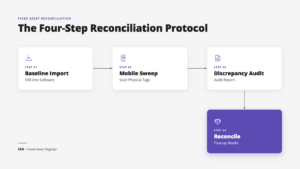
Step 1: Establish the Baseline Match
First, export your current financial Fixed Asset Register into your asset management software.
Map key financial fields directly to your operational equipment profiles. Include the Asset ID, description, purchase date, cost, and serial number. In Bulbthings, this step creates a digital footprint for every capitalized item. It links book value directly to an operational asset record.
Step 2: Run the Physical Mobile Sweep
Equip shop managers and field leads with mobile devices running the Bulbthings app.
Auditors perform a blind location sweep rather than hunting for specific line items:
- Existing Tagged Assets: The auditor scans the physical barcode or QR tag on the machine. The mobile tool immediately logs the GPS timestamp, updates the current location, and marks the asset as verified.
- Untagged Equipment (Potential Zombies): Auditors do not skip untagged equipment. They immediately attach a durable barcode tag and snap a photo. Then, they record the make, model, and serial number, flagging the record as discovered in the field.
Step 3: Review the Exception Report
After the scan sweep, the software compares physical scans against the accounting register. The platform generates an automated exception report divided into three buckets:
-
Matched Assets: Items present on both the register and the physical scan. The system confirms their status, custodian, and location.
-
Missing Items (Potential Ghost Assets): Items on the accounting ledger that received zero physical scans.
-
Unmatched Items (Zombies): Items tagged in the field that have no matching accounting record.
Step 4: Reconcile and Take Operational Action
Now operations and finance sit down with clear facts instead of guesses:
- Retiring Ghost Assets: Operations reviews the missing items list. When teams confirm an asset was lost or scrapped, finance records an immediate write-off. Removing the asset from the register creates an immediate tax deduction and lowers future insurance premiums.
- Capitalizing Field Acquisitions: For discovered zombie assets, finance reviews original receipts or assigns fair market value. Accounting officially adds the asset to the balance sheet. Simultaneously, Bulbthings assigns a preventive maintenance schedule and designates an equipment custodian.
How AI Accelerates Asset Reconciliation
Modern artificial intelligence turns this reconciliation workflow into an automated background process:
- Semantic Fuzzy Matching: Accounting records rarely match field naming habits. Finance might record “2021 CAT 320 GC EXCAV”, while a field scan reads “CAT0320GCZ9012”. AI bridges this gap. It matches cryptic ledger descriptions to physical equipment records with high confidence scores.
- Computer Vision for Worn Nameplates: Metal serial plates often get scratched, greasy, or painted over in harsh environments. AI vision tools read weathered text and damaged serial numbers directly from smartphone photos. This stops manual data entry mistakes.
- Predictive Inactivity Alerts: Machine learning models track asset activity between formal audits. The system flags an asset if it detects zero engine hours and zero maintenance tickets for 90 days.
Why Unified Asset Management Software Makes Audits Painless
Traditional ERP accounting tools fail at physical audits. Software vendors built them for desk-bound accountants, not field technicians. Standalone scanning apps also struggle because they ignore depreciation schedules.
An all-in-one platform like Bulbthings unites both workflows:
- Real-Time Visibility: As soon as a crew scans an asset on a job site, the central office sees its location. This eliminates double counting across regional branches.
- Condition Logging During Scans: Auditors can log equipment health, notes, and photos during every scan. This turns a routine financial check into an operational health assessment.
- Audit-Ready Records: When external auditors or insurers demand proof of asset existence, you can export a complete audit log. It shows who scanned each item, the exact timestamp, and GPS coordinates.
The Bottom Line
Your fixed asset register must reflect what currently powers your business, not what sat in your yard years ago. Ghost assets drain cash through pointless taxes and insurance. Unrecorded field gear leaves expensive equipment vulnerable to loss and neglect.
Adopting a mobile-first audit protocol with an all-in-one asset management software like Bulbthings aligns your balance sheet with physical reality. You empower your field crews with fast mobile scanning tools. You eliminate ghost assets, protect your capital budgets, and maintain complete accountability across your entire equipment fleet.
Ready to eliminate ghost assets and take full control of your equipment fleet? Start your 14-day free trial of Bulbthings today 🚀 Experience how simple physical asset reconciliation can be.